
Application
Breaking concrete without noise, dust clouds and vibration
Separating foundations, plinths, walls and slabs in a controlled way – indoors, during ongoing operation and directly against existing structures.
- Hole diameter
- 30–40 mm
- Spacing, unreinforced
- 25–40 cm
- Spacing, reinforced
- 15–25 cm
- Waiting time
- 8–24 h, then dismantling
Starting point
Dismantling in the middle of existing structures
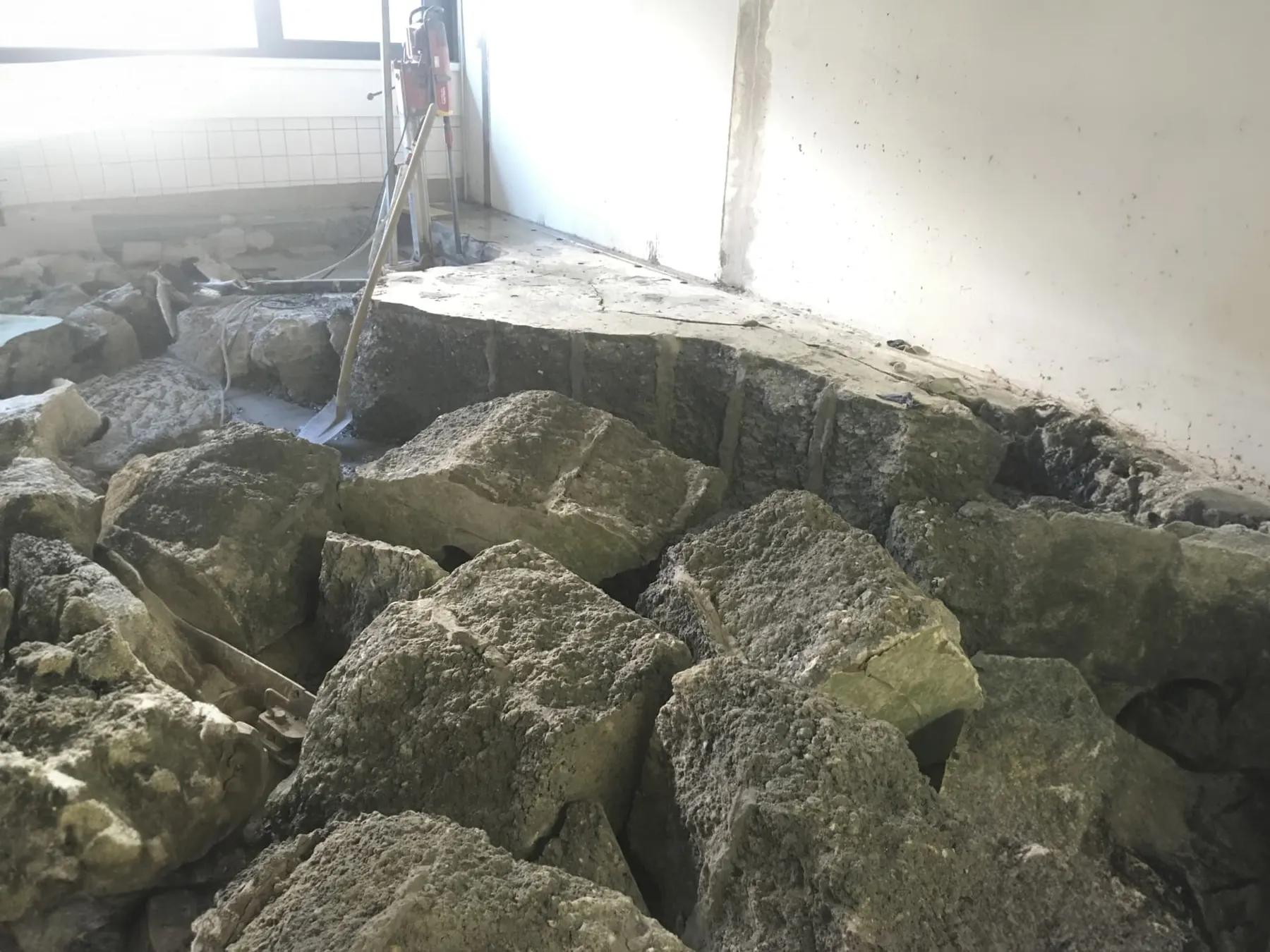
Machine foundations in operating production halls, concrete plinths in basements, lift pits, retaining walls on the property line: when dismantling concrete within existing structures, strength is rarely the problem – the surroundings are. Vibration can affect sensitive machinery, historic building fabric or neighbouring flats, noise limits working hours, and heavy equipment lacks access or floor load capacity.
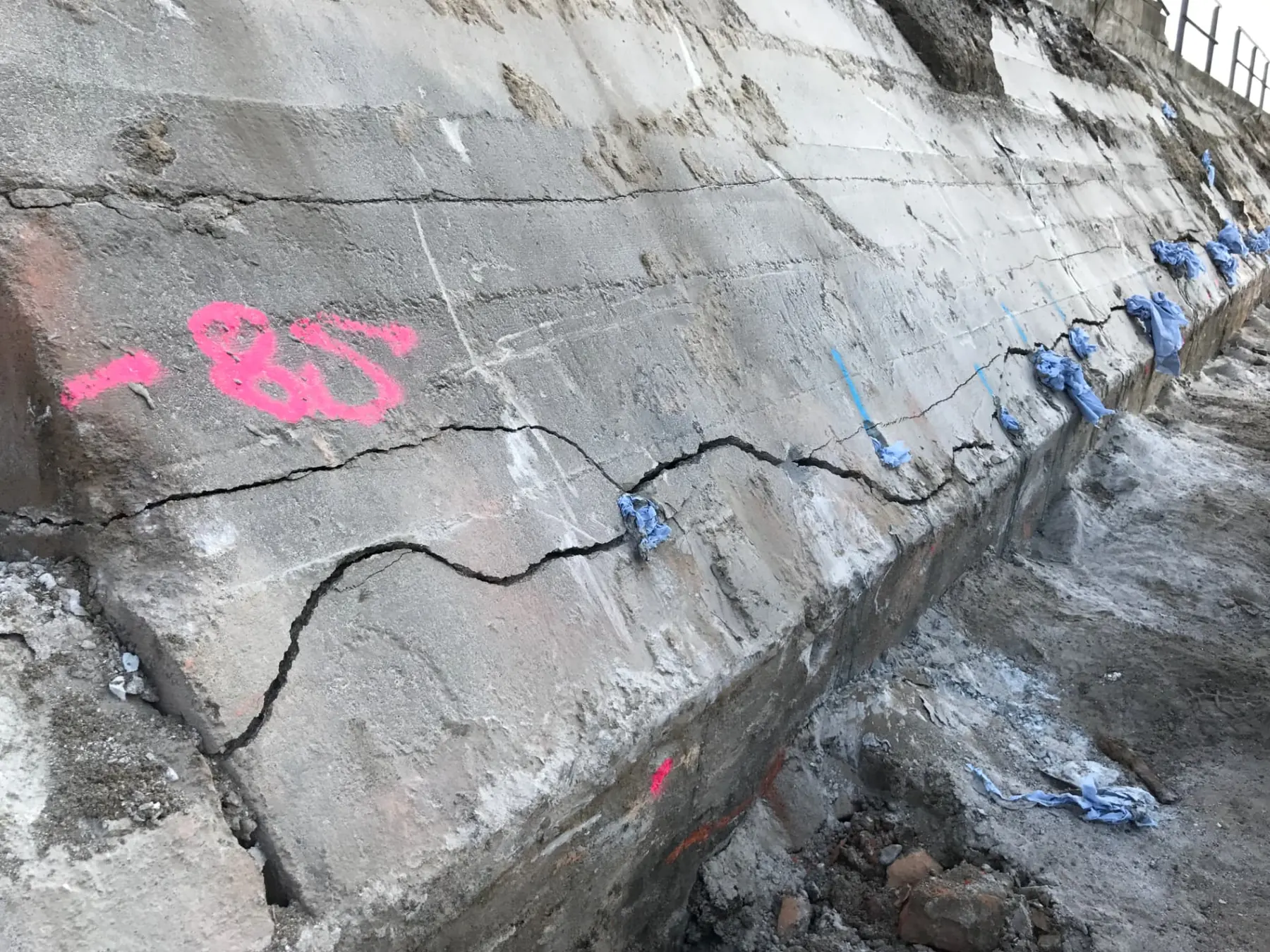
Expansive mortar separates mass concrete through pressure inside the borehole. The element cracks along the row of holes and is then dismantled with an excavator, jaws or by hand. Because the reaction runs unattended, production breaks and nights can be used productively. Reaction time and pressure development explains how the force continues to increase over several days.
Procedure
Separating concrete step by step
01
Locate the reinforcement
Use a rebar detector to determine the position of the steel so holes can be placed between the bars and drilling into them is avoided.
02
Define separation joints
Divide the element into segments that can be transported and lifted. Rows of holes along the joints, with at least one free edge per segment.
03
Drill and clean
30–40 mm holes through nearly the full element thickness, spacing according to the degree of reinforcement. Remove drilling dust and residual water completely.
04
Mix and fill
Mix the material with cold water exactly as specified and fill the holes to the brim without delay. Use a suitable filling technique for horizontal holes.
05
Dismantle and cut the steel
Once cracking has occurred, loosen the segments with jaws or an excavator and cut the exposed reinforcement with an angle grinder or cutting torch.
Fields of use
Typical projects
- Machine and plant foundations in operating facilities
- Concrete plinths, columns and wall panels in interior fit-out
- Foundation demolition during conversion and replacement construction
- Lift pits, shafts and basement openings
- Retaining walls and abutments on the property line
- Concrete elements in power plants, hospitals and security areas
- Dismantling of silo, crane and antenna foundations
- Reworking excess concrete and faulty pours
Assessment
Advantages and limitations with concrete
Advantages
- +Vibration-free – no risk to adjacent elements and equipment
- +Silent separation, work possible even in sensitive facilities
- +No shock wave, no flying debris, minimal safeguarding
- +The reaction runs during production breaks and overnight
- +Very accurate separation joints controlled by the drill pattern
Limitations
- –Reinforcement is not cut and has to be severed separately
- –Tighter drill patterns with heavy reinforcement increase drilling effort
- –A free direction of expansion is a prerequisite
- –A waiting time of 8–24 hours must be scheduled
Fundamentals and working principle: expansive mortar. Alternatives compared: demolition methods. Product for concrete: BETONAMIT®.
FAQ
Frequently asked questions about concrete demolition
+Does expansive mortar work in reinforced concrete?
Yes, but with a tighter drill pattern. The reinforcement absorbs tensile forces, so holes are placed closer together and, wherever possible, in the plane of the planned separation joint. The concrete cracks open, the reinforcement remains and is cut afterwards.
+What hole spacing applies to concrete?
In unreinforced concrete 25 to 40 cm is usual, in heavily reinforced elements 15 to 25 cm. The decisive factors are the desired fragment size and the degree of reinforcement.
+Can it be used indoors?
Yes. There is no bang, no shock wave and no flying rock, and the reaction runs without personnel. For drilling, dust extraction and hearing protection must be considered; the room has to be secured during the reaction.
+Is a free surface necessary?
For cracking, the element needs a direction in which it can open. With elements restrained on all sides, a free edge is created first, for example with a row of core holes or a saw cut.
Read on
Related topics
Expansive mortar
How it works, how it developed, drill patterns and the limits of non-explosive splitting – explained concisely.
Alternative demolition methods
Hammer, wire saw, splitting cylinder, conventional blasting or expansive mortar: when each method pays off.
Rock excavation
Building pits, road construction, tunnel re-profiling – breaking rock without vibration and without a blasting permit.
Splitting boulders
From field stones to 50-tonne blocks: drill, fill, wait – without flying debris and without vibration.
Reaction time
First cracks after 8–16 hours are only the beginning: pressure continues to rise for several days and peaks after about one week.
Drill pattern
10 × Ø rule, conservative 6–8 × Ø starting value, half spacing at a free edge and sufficiently deep boreholes: the fundamentals of a good drill pattern.
Business location Liechtenstein
Highly industrialised, politically and financially stable, globally connected: the location behind BETONAMIT® and ROCKSPLIT®.
Mechanical application
Mix and pump BETONAMIT by machine: tonnes instead of kilograms – process, MAI mixing pump, water setting of 1.0–1.2 litres per 5 kg and safety.
Plan your concrete dismantling
We review the element, reinforcement and site conditions and recommend drill pattern and quantity.