
How it works
Reaction time and pressure development
BETONAMIT® does not act suddenly. Its controlled effect develops over several days. Why the first cracks are only the beginning – and why waiting pays off.
- First cracks
- typically after 8–16 hours
- Pressure at first cracks
- only about 25–40% of maximum
- Maximum pressure
- over 15,000 PSI / over 1,000 bar
- Full pressure development
- after about 7 days
Basic principle
Controlled reaction instead of sudden force
BETONAMIT® develops its effect over an extended period. It first sets inside the borehole, then pressure starts to build and continues rising for several days.
This behaviour is a key advantage. The first cracks appear while only a comparatively small part of the maximum pressure has developed, leaving considerable force available to open the material further.
Influencing factors
Temperature determines reaction speed
Reaction time is strongly influenced by temperature. The outside temperature alone is not decisive.
- temperature of the rock or concrete
- temperature of the mixing water
- temperature of the BETONAMIT® powder
Heat accelerates setting and pressure development; cold delays every phase.
The powder itself stores heat or cold. The times below are typical guidance for normal conditions at about 10–25 °C.
Sequence
The phases of the reaction
01
Mixing and filling
Mix BETONAMIT® with the specified water quantity for about two minutes and fill it within the working time. No relevant pressure has developed yet.
02
Setting in the borehole (about 1–3 hours)
The material first stabilises and effectively seals itself in the hole. Significant expansion starts only after this setting phase.
03
Pressure starts building
Radial pressure then rises continuously, hour by hour, against the borehole wall rather than being released explosively.
04
Cracking zone (about 8–16 hours)
Visible cracks usually appear after 8–16 hours. Depending on temperature, water, material, borehole geometry and workmanship, this zone can extend to about 24 hours.
Pressure curve
The first cracks are only the beginning
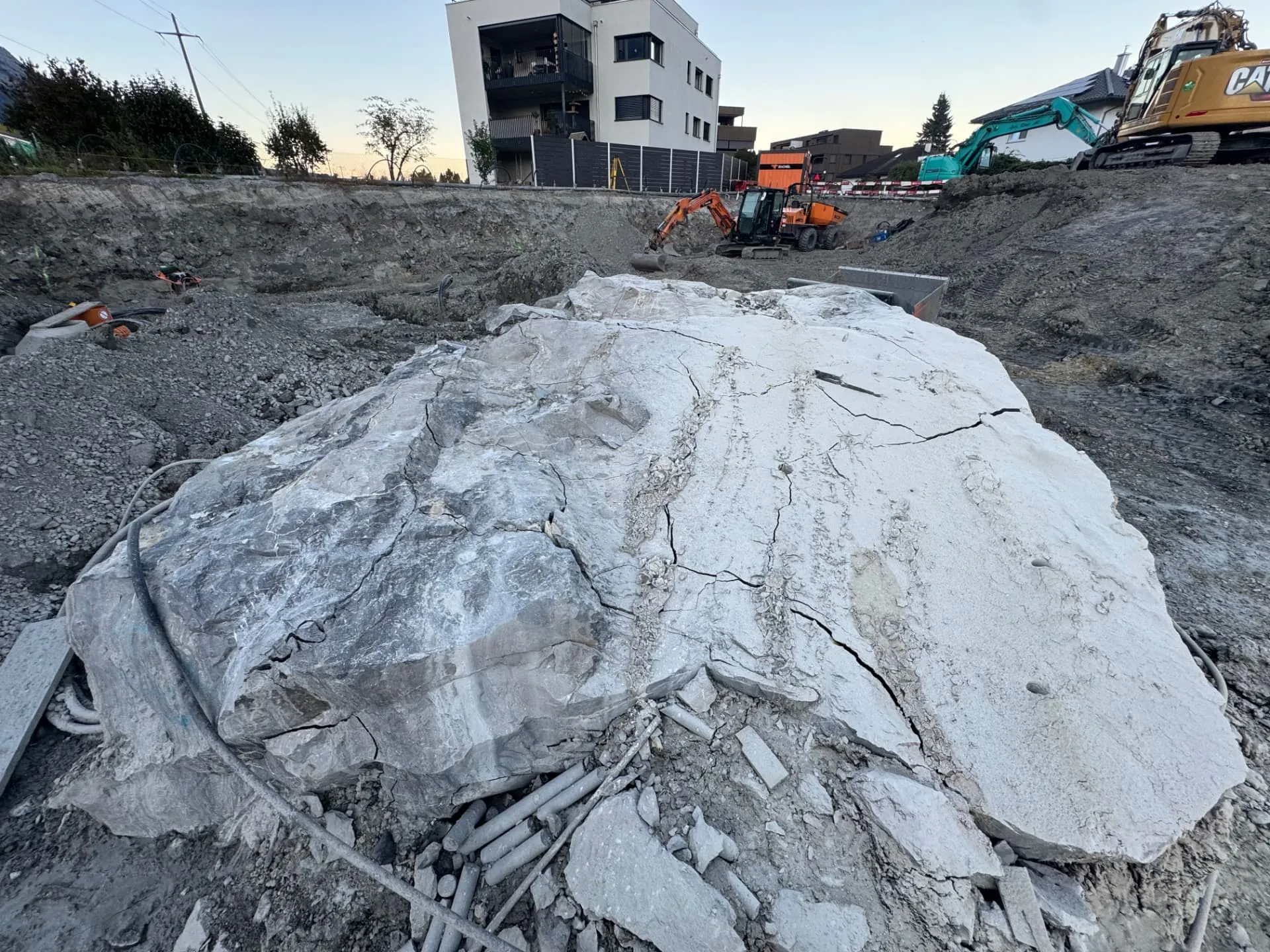
At the first cracks, BETONAMIT® has typically reached only 25–40% of its maximum pressure. A relatively small part of the available force is enough to initiate cracking.
It is therefore wrong to regard the reaction as complete as soon as the first cracks appear.
Pressure continues to rise over the following hours and days, making cracks longer, wider and deeper and creating additional fractures.
Pressure still increases markedly until about day 4. The curve then gradually flattens, with full pressure reached after approximately 7 days.
Force
Very high expansive pressure
BETONAMIT® can develop more than 15,000 PSI or 1,000 bar of radial pressure against the borehole wall.
Unlike blasting, this force is not released suddenly. It builds in a controlled way and continuously loads the material in tension until cracks form and open further.
Practical benefit
Time can partly compensate for application errors
Because substantial pressure reserve remains at the first cracks, giving the material more time can improve a weak initial result.
- slightly too much water was used
- mixing was not optimal
- temperature is unfavourable
- borehole geometry is not optimal
- material is harder or more massive than expected
A result that seems insufficient after 12 or 24 hours can improve significantly over the following days.
Do not assess too early. BETONAMIT® continues working for several days.
Summary
Key message
The first cracks mark the beginning of the visible effect, not the end of the reaction. After 8–16 hours, only about 25–40% of maximum pressure has typically developed.
Pressure keeps rising for several days and reaches its maximum after roughly one week.
All times are guidelines. Powder, water and material temperatures have a major influence: warmth accelerates the reaction, cold extends it.
FAQ
Frequently asked questions about reaction time
+After how many hours do the first cracks appear?
Under normal conditions, typically after 8–16 hours, with the zone extending to about 24 hours. Temperature, water quantity, material and borehole geometry can shift this point.
+Has BETONAMIT® finished reacting when the first cracks appear?
No. Only about 25–40% of maximum pressure has developed. Pressure continues to rise for several days and keeps opening the cracks.
+When is maximum pressure reached?
Full pressure development is reached after about 7 days. Pressure still rises markedly until around day 4, then the curve gradually flattens.
+What if little has happened after 24 hours?
Do not assess too early. Especially in cold or unfavourable conditions, the result can improve significantly over the following days.
Read on
Read on
Expansive mortar
How it works, how it developed, drill patterns and the limits of non-explosive splitting – explained concisely.
Alternative demolition methods
Hammer, wire saw, splitting cylinder, conventional blasting or expansive mortar: when each method pays off.
Rock excavation
Building pits, road construction, tunnel re-profiling – breaking rock without vibration and without a blasting permit.
Splitting boulders
From field stones to 50-tonne blocks: drill, fill, wait – without flying debris and without vibration.
Concrete demolition
Separating foundations, plinths and mass concrete in a controlled way indoors and in populated surroundings.
Drill pattern
10 × Ø rule, conservative 6–8 × Ø starting value, half spacing at a free edge and sufficiently deep boreholes: the fundamentals of a good drill pattern.
Business location Liechtenstein
Highly industrialised, politically and financially stable, globally connected: the location behind BETONAMIT® and ROCKSPLIT®.
Mechanical application
Mix and pump BETONAMIT by machine: tonnes instead of kilograms – process, MAI mixing pump, water setting of 1.0–1.2 litres per 5 kg and safety.
Plan your application
We advise you on the drill pattern, quantity and schedule for your project.