
Application
Rock excavation without blasting and without vibration
Building pits, utility trenches, road construction and re-profiling: how rock is broken in a controlled way with expansive mortar – drill pattern, consumption and field experience.
- Hole diameter
- 30–45 mm, typically 38–40 mm
- Hole spacing
- 8–12 × hole diameter
- Consumption
- approx. 1 kg per 0.55 l of borehole
- Waiting time
- 8–24 h until cracking
Starting point
When blasting and hammering are not an option
Rock in the subsoil is rarely where it bothers no one. Building pits border on existing houses, utility trenches run alongside supply lines, access roads cut through steep slopes above residential areas. In all these cases the classic routes are restricted: conventional blasting fails on permits, safety distances and vibration assessments; the hydraulic hammer fails on noise limits, access or concerns about cracks in neighbouring buildings.
Expansive mortar breaks rock through a slow build-up of pressure inside the borehole. There is no shock wave, no flying rock and no measurable vibration. This allows work directly next to existing structures, beneath foundations, on slopes and in tunnels. See drill patterns, borehole spacing and drilling depth for detailed layout guidance.
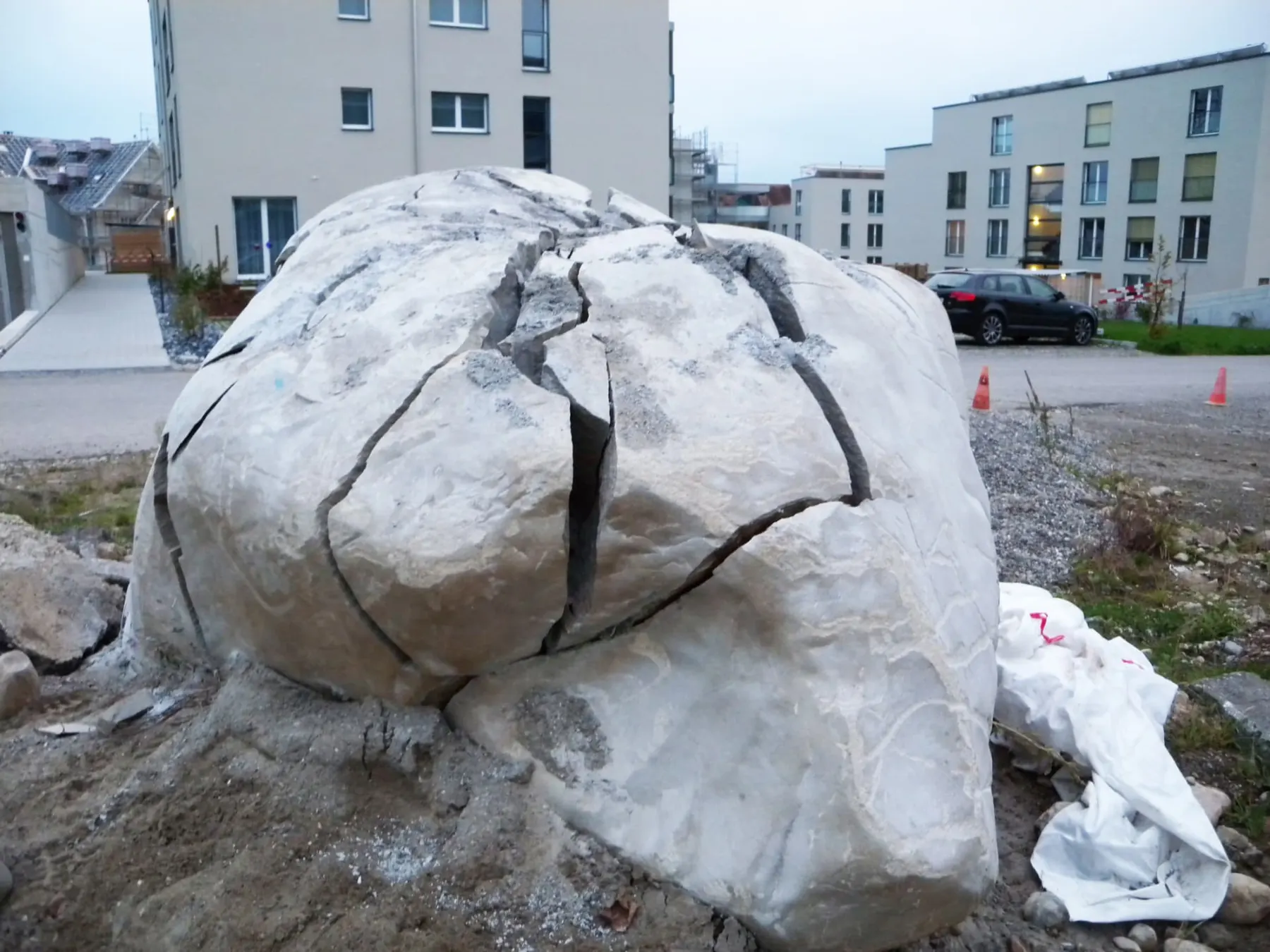
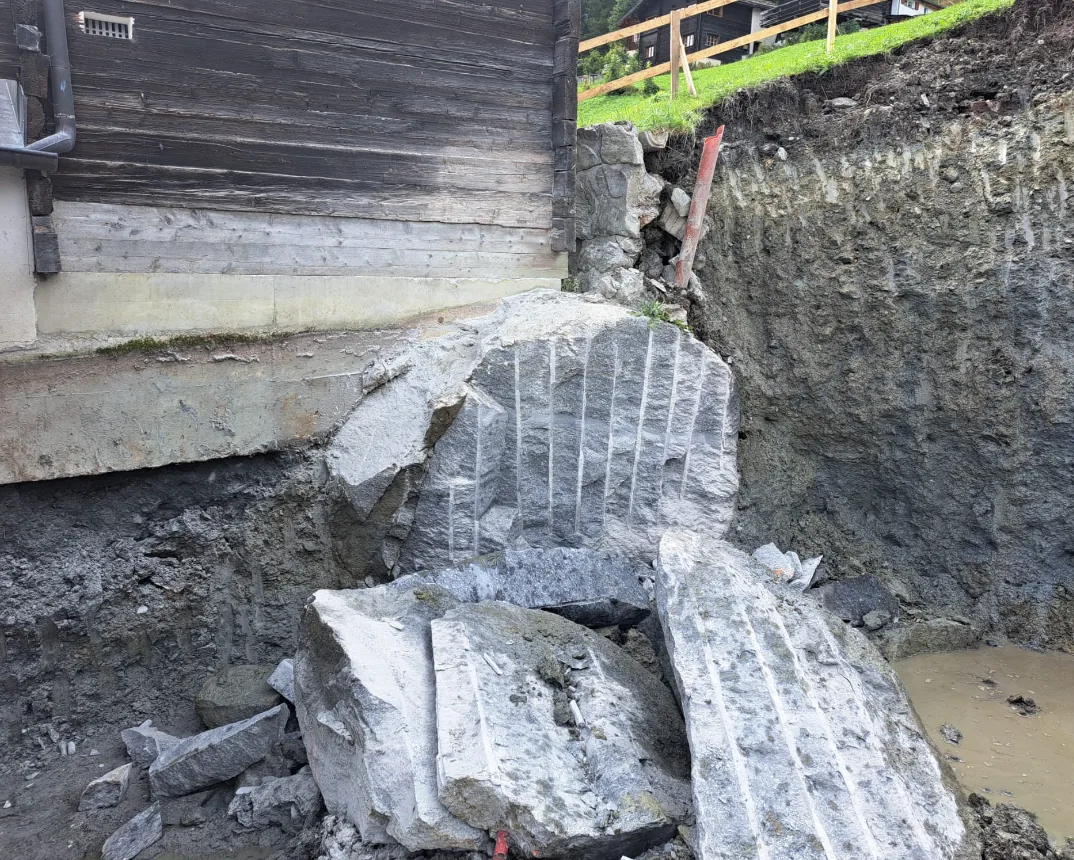
Procedure
Rock excavation step by step
01
Define the separation line
Mark the excavation edge or target profile. Use existing joints and bedding planes: place boreholes parallel to the intended crack plane.
02
Execute the drill pattern
Rows of holes 30–50 cm apart, closer in very tough rock. Hole depth 80–95 % of the height to be broken, drilled as parallel as possible.
03
Clean the boreholes
Blow out drilling dust and remove water. In heavily jointed rock, close larger cavities beforehand so the material does not drain away.
04
Mix and fill
Mix with cold water as specified and fill the holes quickly and completely. Adapt the filling technique for horizontal or inclined holes.
05
Wait and remove
After 8–24 hours the rock has cracked. Loosen the segments with an excavator, sorting grab or jaws, remove them and re-drill remaining stubs.
Fields of use
Typical projects
- Excavating building pits in rock next to existing structures
- Utility and sewer trenches in rocky subsoil
- Access and forest roads on steep slopes
- Re-profiling of tunnels, galleries and shafts
- Removing rock heads for slope stabilisation and rockfall prevention
- Excavation in ski areas and alpine terrain without machine access
- Rock near railway installations and traffic routes while in operation
- Extraction of natural stone blocks with minimal crack damage
Assessment
Advantages and limitations in rock excavation
Advantages
- +No blasting permit and no evacuation of the surroundings
- +No vibration on adjacent structures
- +Work possible in narrow pits, shafts and interiors
- +Very little equipment – drill rig, stirrer, water
- +Neighbour-friendly: no bang, hardly any dust, no flying rock
Limitations
- –Drilling performance in hard rock determines schedule and cost
- –Result only on the following day – the schedule must allow for the waiting time
- –Heavily jointed, water-bearing rock requires additional effort
- –For very large daily volumes blasting is more economical
Detailed method comparison: alternative demolition methods. Fundamentals of the method: expansive mortar.
FAQ
Frequently asked questions about rock excavation
+What hole spacing makes sense in rock?
As a rule of thumb, 8 to 12 hole diameters. With 40 mm holes that is roughly 30 to 50 cm. In tough, unjointed rock drill closer together; in jointed material the spacing can be larger.
+Does the method work in granite and basalt?
Yes. Hard rock such as granite, gneiss, basalt or quartzite splits well because its tensile strength is well below the achievable borehole pressure. What matters is a cleanly executed drill pattern over the full block height.
+Is rock excavation with expansive mortar possible in winter?
Yes, with the product variant designed for low temperatures and insulated boreholes. Below a rock temperature of roughly 5 °C the reaction time increases considerably; the holes should then be covered.
+How deep should the holes be?
A drilling depth of about 80 to 95 percent of the height to be separated is advisable. Holes that are too short leave stubs that have to be reworked.
Read on
Related topics
Expansive mortar
How it works, how it developed, drill patterns and the limits of non-explosive splitting – explained concisely.
Alternative demolition methods
Hammer, wire saw, splitting cylinder, conventional blasting or expansive mortar: when each method pays off.
Splitting boulders
From field stones to 50-tonne blocks: drill, fill, wait – without flying debris and without vibration.
Concrete demolition
Separating foundations, plinths and mass concrete in a controlled way indoors and in populated surroundings.
Reaction time
First cracks after 8–16 hours are only the beginning: pressure continues to rise for several days and peaks after about one week.
Drill pattern
10 × Ø rule, conservative 6–8 × Ø starting value, half spacing at a free edge and sufficiently deep boreholes: the fundamentals of a good drill pattern.
Business location Liechtenstein
Highly industrialised, politically and financially stable, globally connected: the location behind BETONAMIT® and ROCKSPLIT®.
Mechanical application
Mix and pump BETONAMIT by machine: tonnes instead of kilograms – process, MAI mixing pump, water setting of 1.0–1.2 litres per 5 kg and safety.
Break rock without vibration
We calculate the drill pattern and material requirement for your volume and deliver worldwide.