
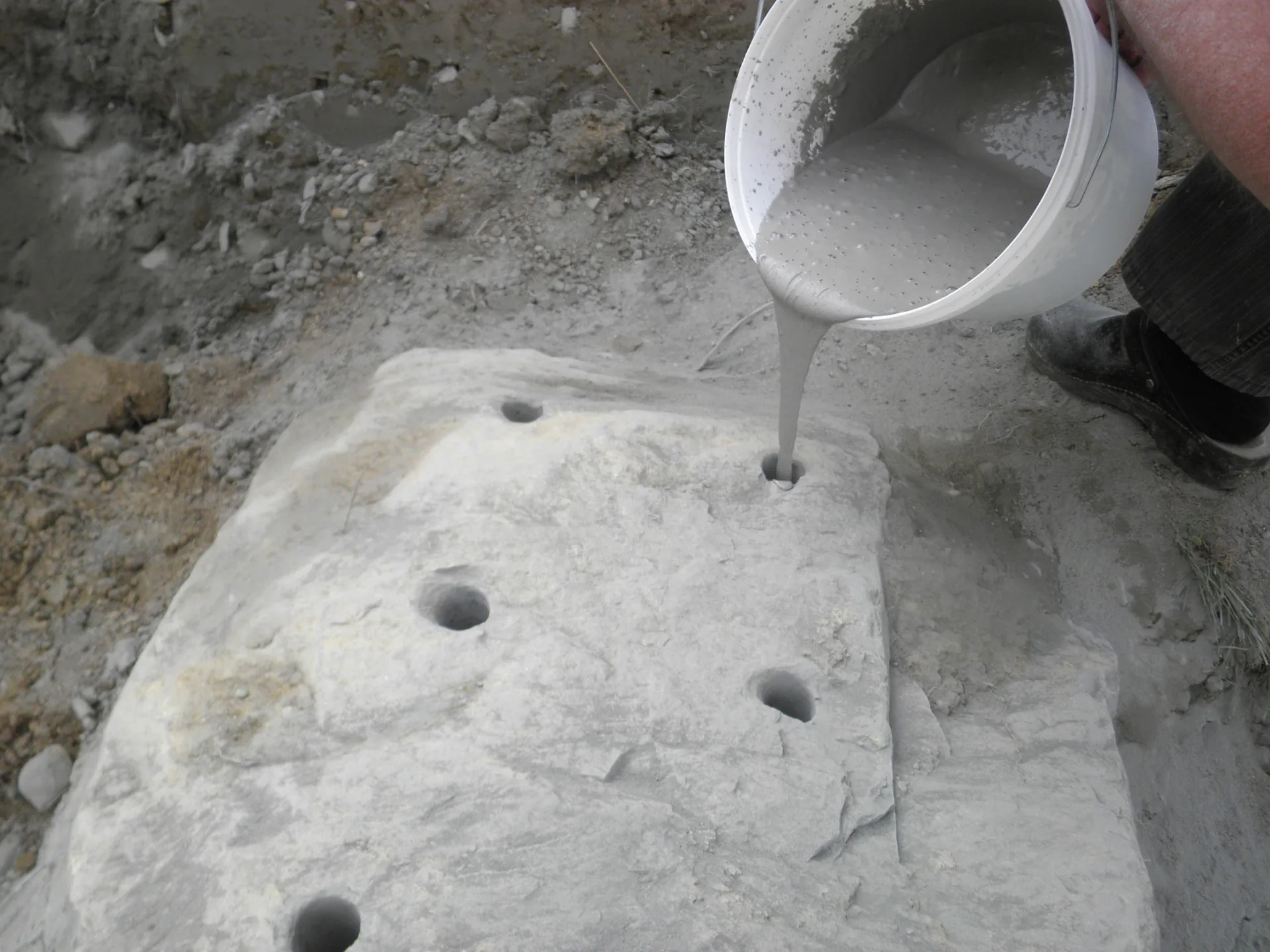
Controlled rock splitting
The field video shows BETONAMIT® splitting rock in a controlled way without explosives.
BETONAMIT® in action: controlled rock splitting without blasting.
Betonamit
Non-explosive cracking agent for the safe and controlled demolition of rock and concrete – developed and produced in Liechtenstein.
Product

Betonamit is an non-explosive cracking agent for the gentle and controlled demolition of rock and concrete. Betonamit is the gentle and environmentally friendly alternative compared to conventional demolition methods. Where blasting is not permitted or desired, where chiseling places an enormous strain on workers, or vibrations must be avoided, Betonamit offers exactly the right solution.
As a European manufacturer, we have achieved an internationally leading position with our quality product. Production still takes place at our plant in Liechtenstein. For our non-explosive cracking agent, we use exclusively raw materials from Switzerland and the EU. Today we manufacture for countless renowned companies worldwide and produce our products both under our own brand and as numerous private labels on behalf of our customers.
Standard packaging
Quality features and USPs
Betonamit websites/online shops
From one pallet upwards, it pays to contact us directly: when timing is not critical, buying directly from KUBATEC is usually the most economical option. Simply request a non-binding quote.
Application
Please have the following equipment ready before you start:
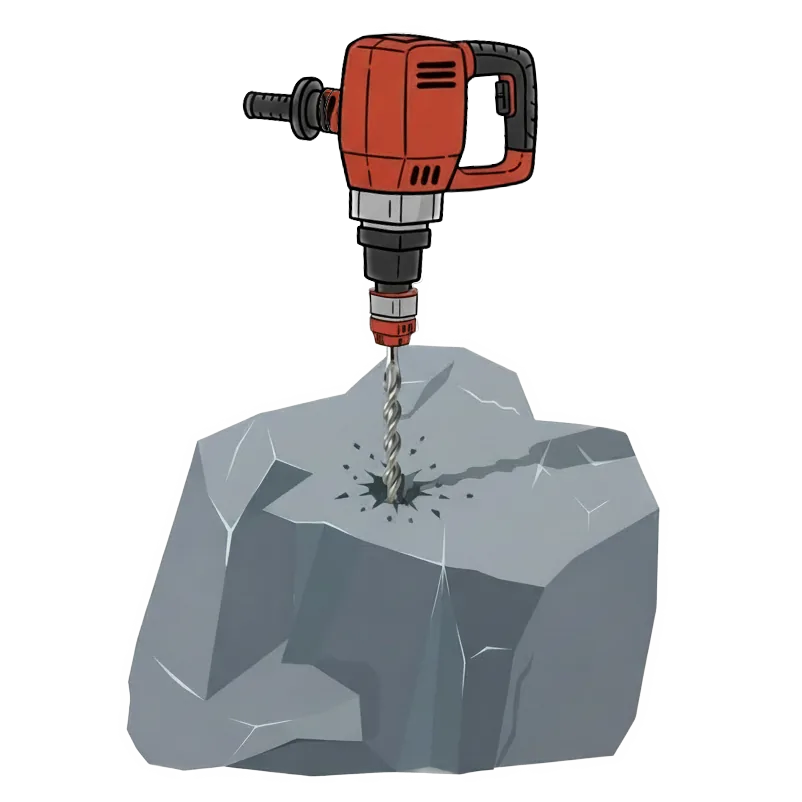 1.Drill the holes according to the technical specifications – as dust-free and dry as possible.
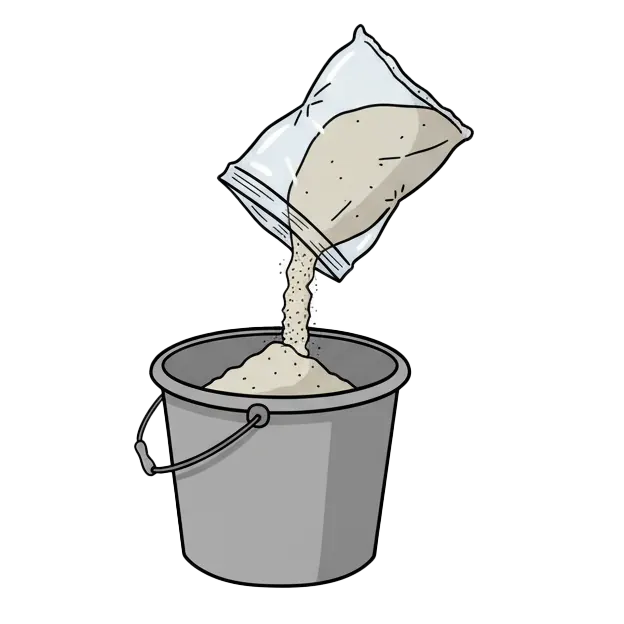 2.Pour the BETONAMIT® powder into the mixing container.
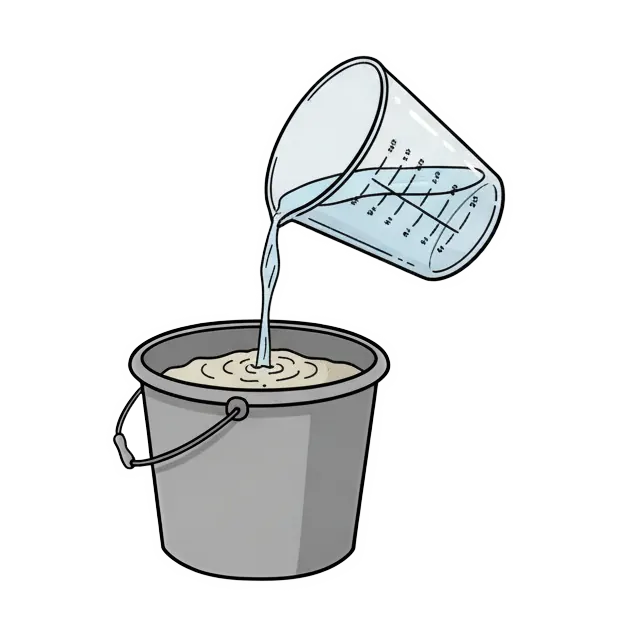 3.Add 1.2 litres of cold, clean water per 5 kg (max. 20 °C).
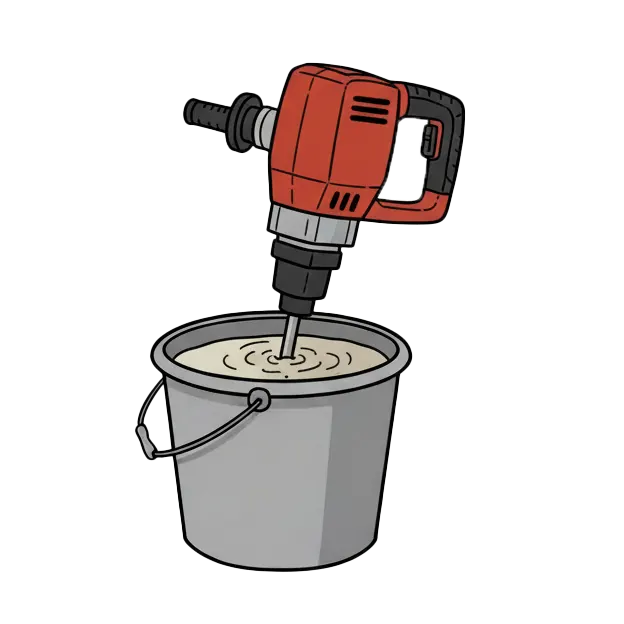 4.Mix mechanically for 2 minutes until the mixture is fluid and homogeneous.
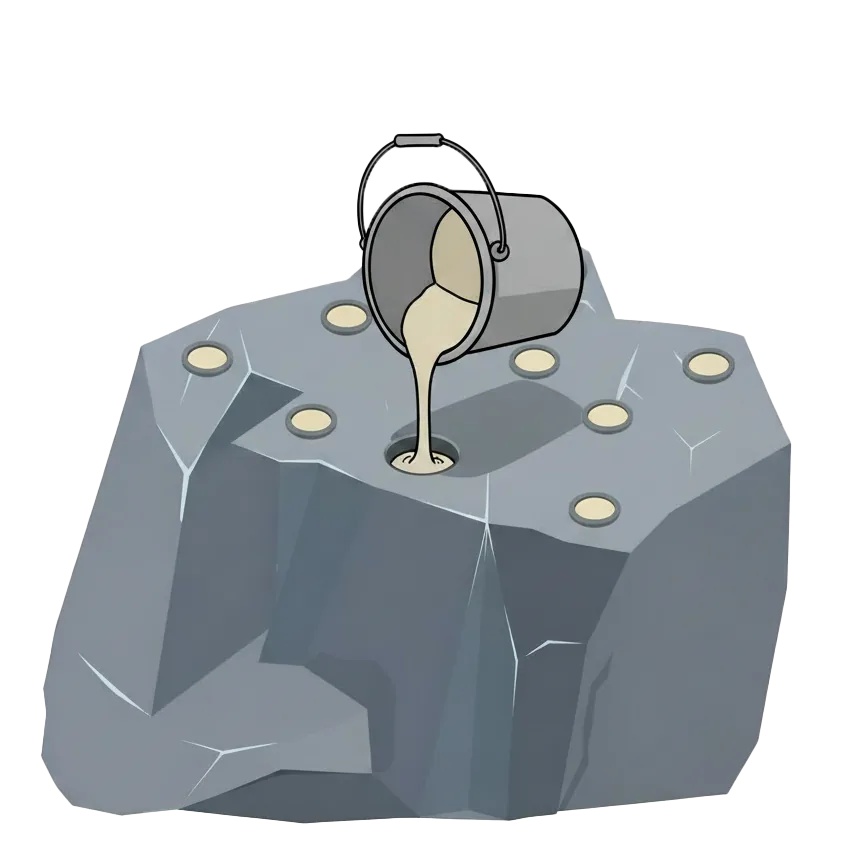 5.Fill the mixture into the boreholes immediately, straight from the container.
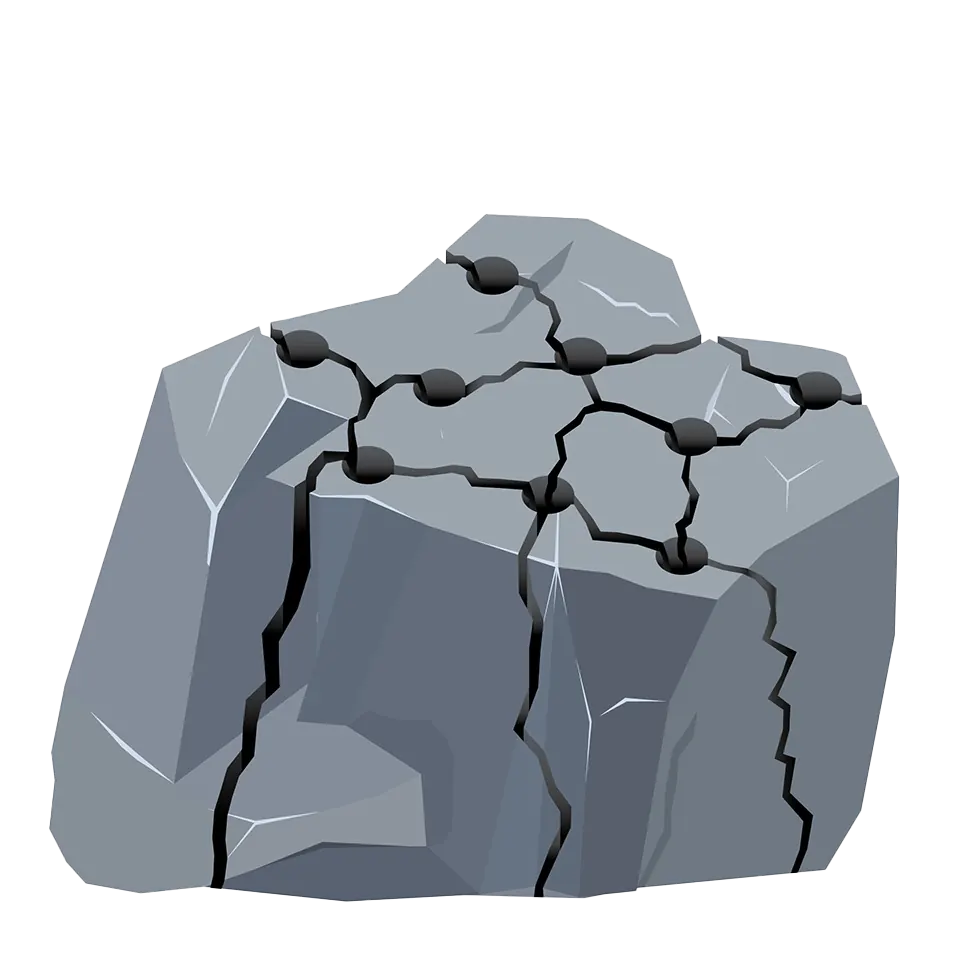 6.Let it react – cracks always form in the direction of least resistance.
The maximum borehole spacing is 10 times the borehole diameter; smaller spacing gives even better results. The mixture appears dry at first but changes consistency abruptly during mixing. Dilute surplus mixture with plenty of water to deactivate it and dispose of it with the remaining construction debris.
How to select borehole spacing, depth and pattern: Drill patterns, borehole spacing and drilling depth
Application
To achieve the best possible result, these specifications are decisive:
| Temperature (object) | 0 – 15 °C | 15 – 25 °C | 25 – 35 °C |
|---|---|---|---|
| Drill diameter (Ø borehole) | 30–50 mm | 30–45 mm | 30–40 mm |
| Maximum borehole spacing | 10 × Ø borehole | 10 × Ø borehole | 10 × Ø borehole |
| Water per 5 kg | 1.2 litres | 1.2 litres | 1.2 litres |
| Reaction time | 12–96 h | 6–72 h | 2–48 h |
How pressure develops over the hours and days after filling: Reaction time and pressure development
Drilling instructions
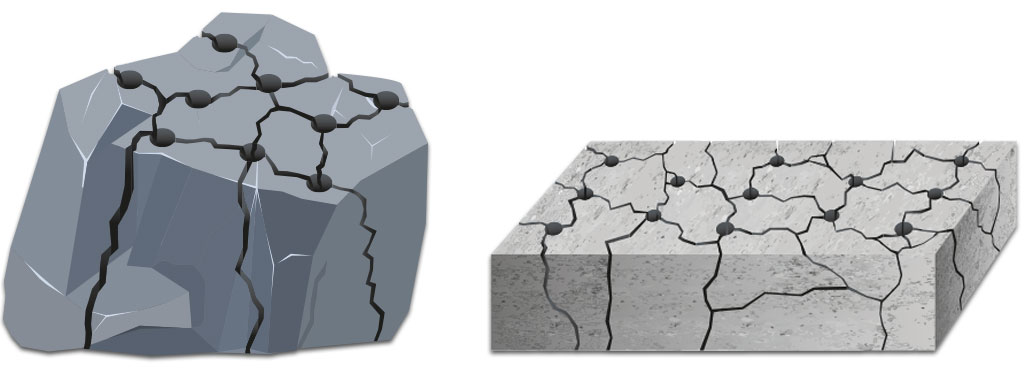
Cracks always form in the direction of least resistance. A larger borehole diameter means more force, shorter reaction time and wider cracks. Smaller borehole spacing means smaller fragments and a shorter reaction time. The drilling depth should be at least ¾ of the total depth.
Tip: BETONAMIT® keeps expanding over several days. The more time you give the product, the easier it is to remove the fragments.
More about drill patterns, spacing and drilling depth: Technical drilling details

Drilling instructions
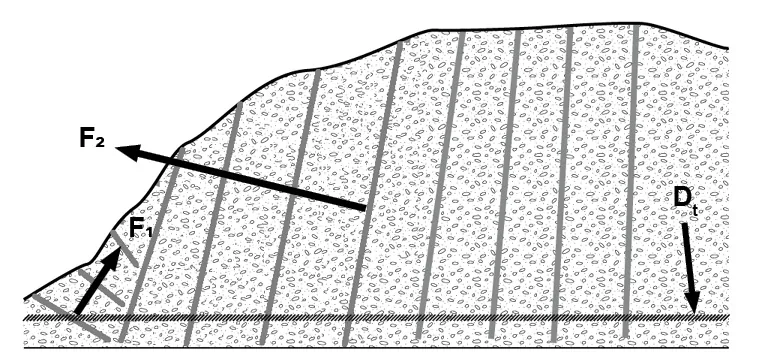
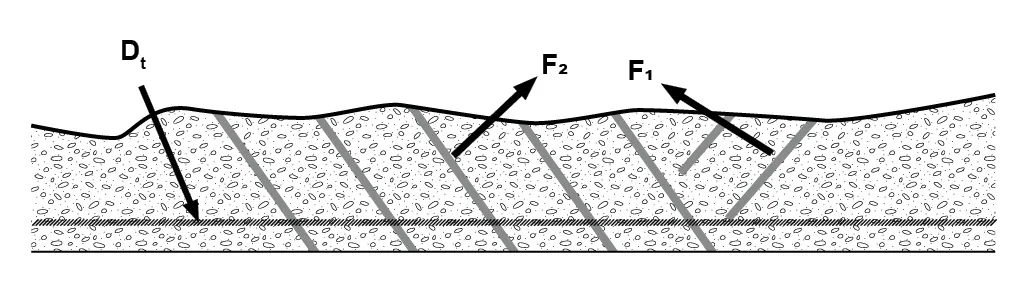
The target level is usually over-drilled by 5–15 cm to avoid subsequent chiselling work. The expansion pressure (F) always develops at 90° to the borehole. Angled boreholes therefore create a free face even in unfavourable situations, where the pressure and material can escape. All rows can be filled at the same time: cracks form in the front row first, then each following row pushes on.
Application example
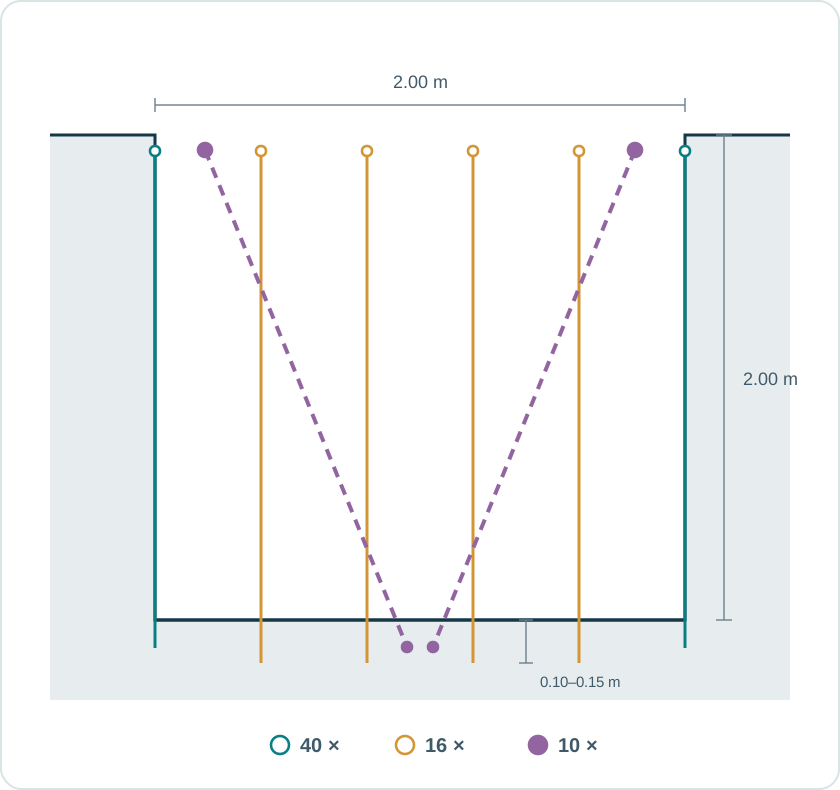
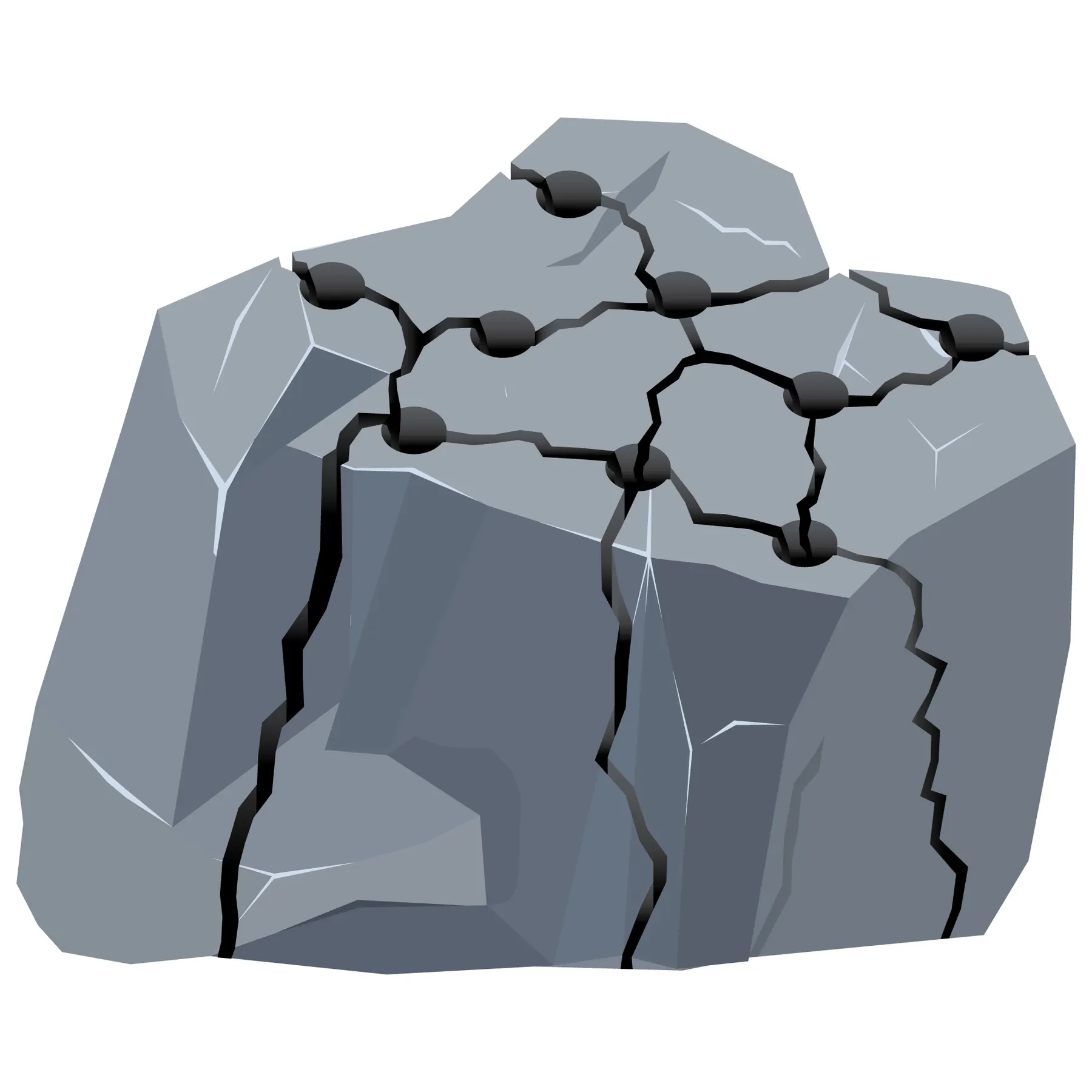
When excavating a shaft in a flat rock surface, there is initially no free face towards which the rock can move. BETONAMIT® builds up pressure in the drill holes and creates cracks in the rock. With a dense drilling pattern and additional inclined holes reaching below the planned bottom, even an excavation enclosed by rock on all sides can be prepared. The broken material can then be removed mechanically.
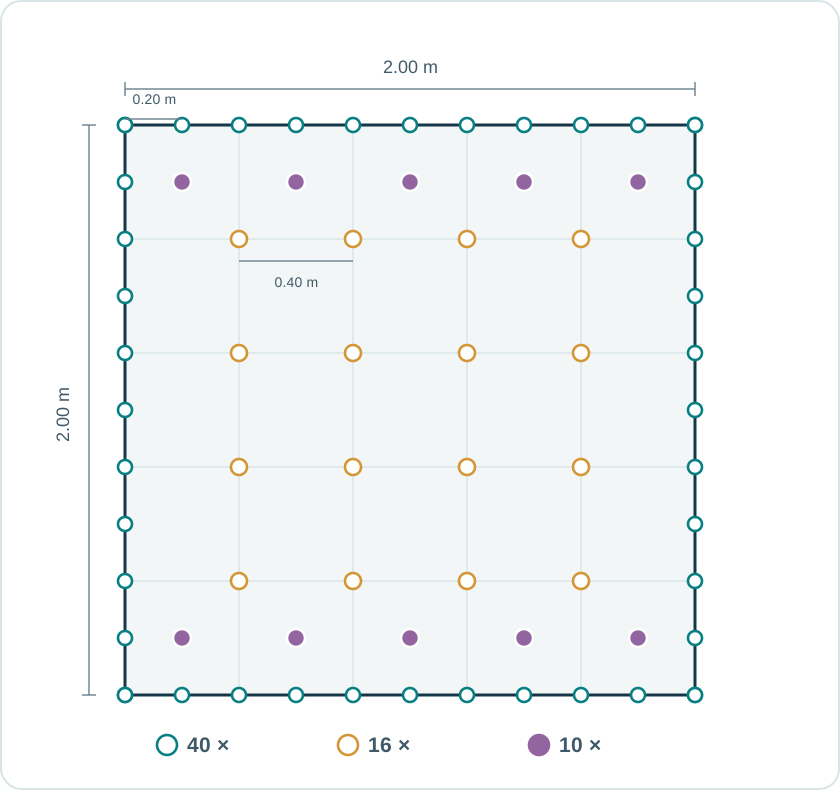
All holes are filled with BETONAMIT®. The material should then be left to act for at least one day, preferably two to three days. The broken rock is then excavated.
The diagram shows a deliberately dense layout for a shaft excavation without a free face. Hole position, number and depth must be adapted to the actual rock conditions and the desired result. The section shows the inclined holes schematically.
This example can be adapted to a wide range of requirements and situations. It illustrates the principle: inclined holes lift the material and thus create the free space the rock needs to break.
More about drill patterns, borehole spacing and drilling depth: Technical drilling details
Application
The simplest way to estimate consumption: breaking up 1 m³ of rock, stone or concrete requires approx. 10 kg of BETONAMIT®.
Consumption per metre of borehole depends on the borehole diameter. Multiply the total length of all boreholes in metres by the relevant factor. Example: 10 holes × 0.3 m depth × 2.2 kg (Ø 40 mm) = 6.6 kg BETONAMIT®.
| Ø borehole | kg per drilled metre |
|---|---|
| 20 mm | 0.55 kg |
| 25 mm | 0.86 kg |
| 30 mm | 1.24 kg |
| 31 mm | 1.32 kg |
| 32 mm | 1.41 kg |
| 33 mm | 1.50 kg |
| 34 mm | 1.59 kg |
| 35 mm | 1.68 kg |
| 36 mm | 1.78 kg |
| 37 mm | 1.88 kg |
| 38 mm | 1.98 kg |
| 39 mm | 2.09 kg |
| 40 mm | 2.20 kg |
| 41 mm | 2.31 kg |
| 42 mm | 2.42 kg |
| 43 mm | 2.54 kg |
| 44 mm | 2.66 kg |
| 45 mm | 2.78 kg |
| 50 mm | 3.44 kg |
| 55 mm | 4.16 kg |
| 60 mm | 4.95 kg |
Estimate the BETONAMIT® quantity required for your drilling pattern.
Result
Choose packaging and quantity. BETONAMIT® can be delivered as individual cartons, pallets, truckloads or in containers. We prepare an individual quote tailored to your needs.
Send price requestGuide values without warranty. Allow a 5–10 % reserve depending on drilling accuracy and losses.
Application
Checklist for safe application
Caution: what is a blow-out effect?
Failure to follow the instructions, improper handling or conditions that are too warm can cause a blow-out – the sudden, explosive escape of BETONAMIT® from the borehole. Being hit in the face by material escaping under high pressure can cause serious injuries. Never look directly into filled boreholes and wear safety goggles at all times. After a first blow-out it repeats about 3–6 times and can also occur in other boreholes. Close the work area to all persons for at least 3 hours.
Immediate measures
BETONAMIT® is not toxic, but contains a high proportion of quicklime (calcium oxide). IF IN EYES: rinse cautiously with water for several minutes, remove contact lenses if possible, continue rinsing. IF ON SKIN: wash with plenty of soap and water. In case of pain, injury or allergic reaction, consult a doctor immediately.
Extract from the official BETONAMIT® instructions for use. The full version is available as a PDF in the download section.
Documents
Product brochures – downloads
Safety data sheets – downloads
Packaging
BETONAMIT® is available in boxes, bags and resealable buckets – and on request in customer-specific packaging.
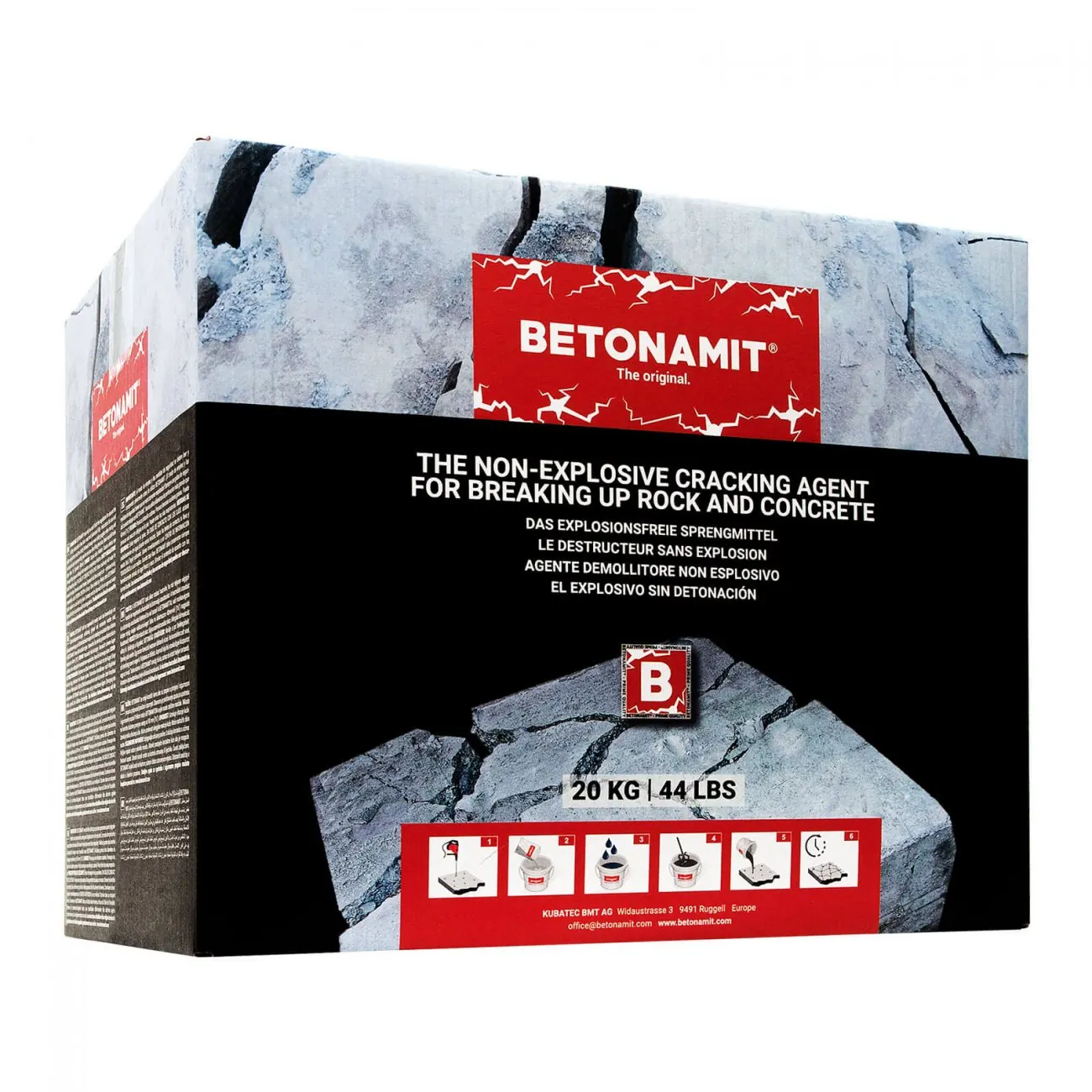
Box 20 kg
4 × 5 kg bags | 44 lbs
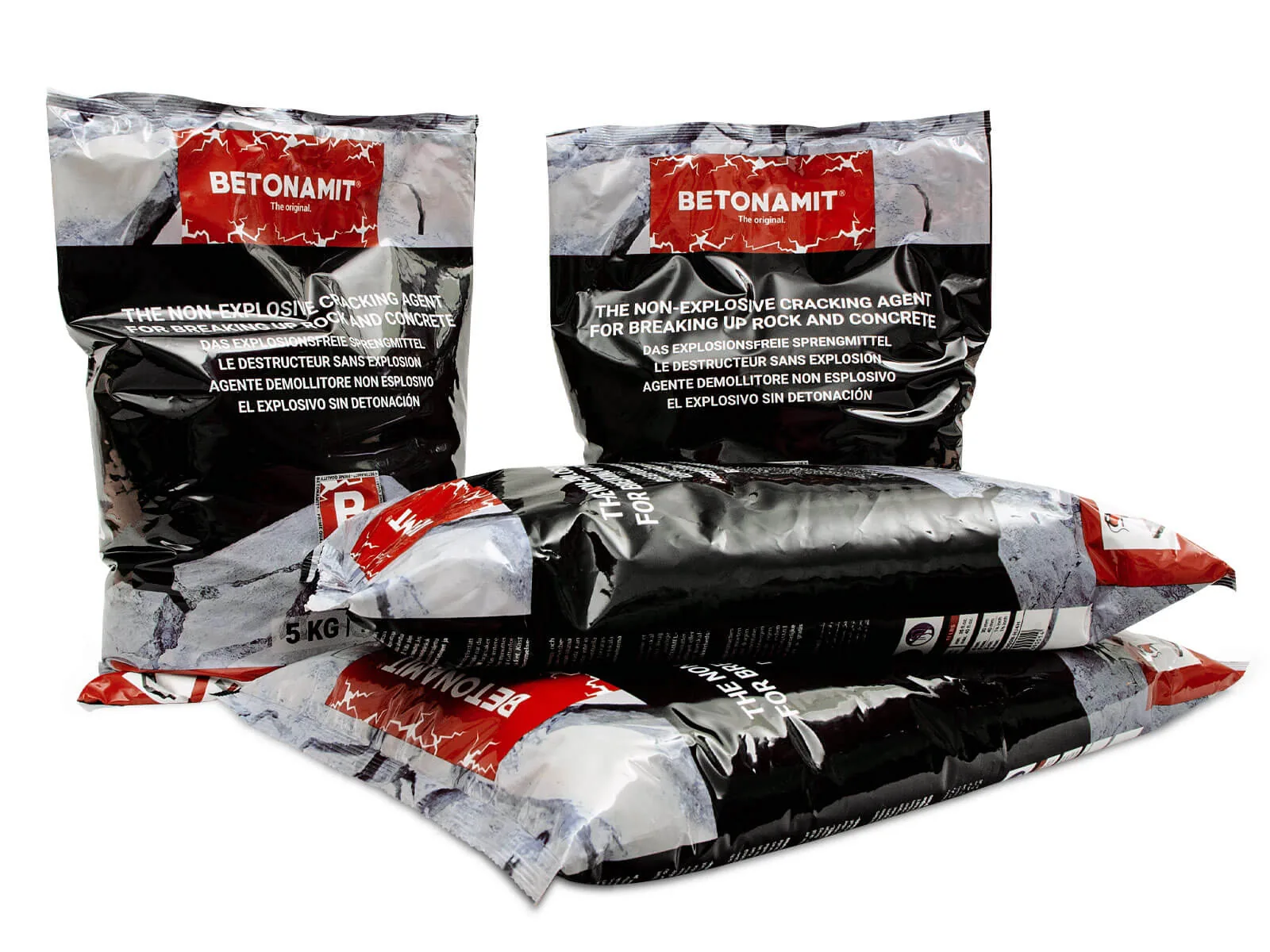
Box content
Four 5 kg bags per box
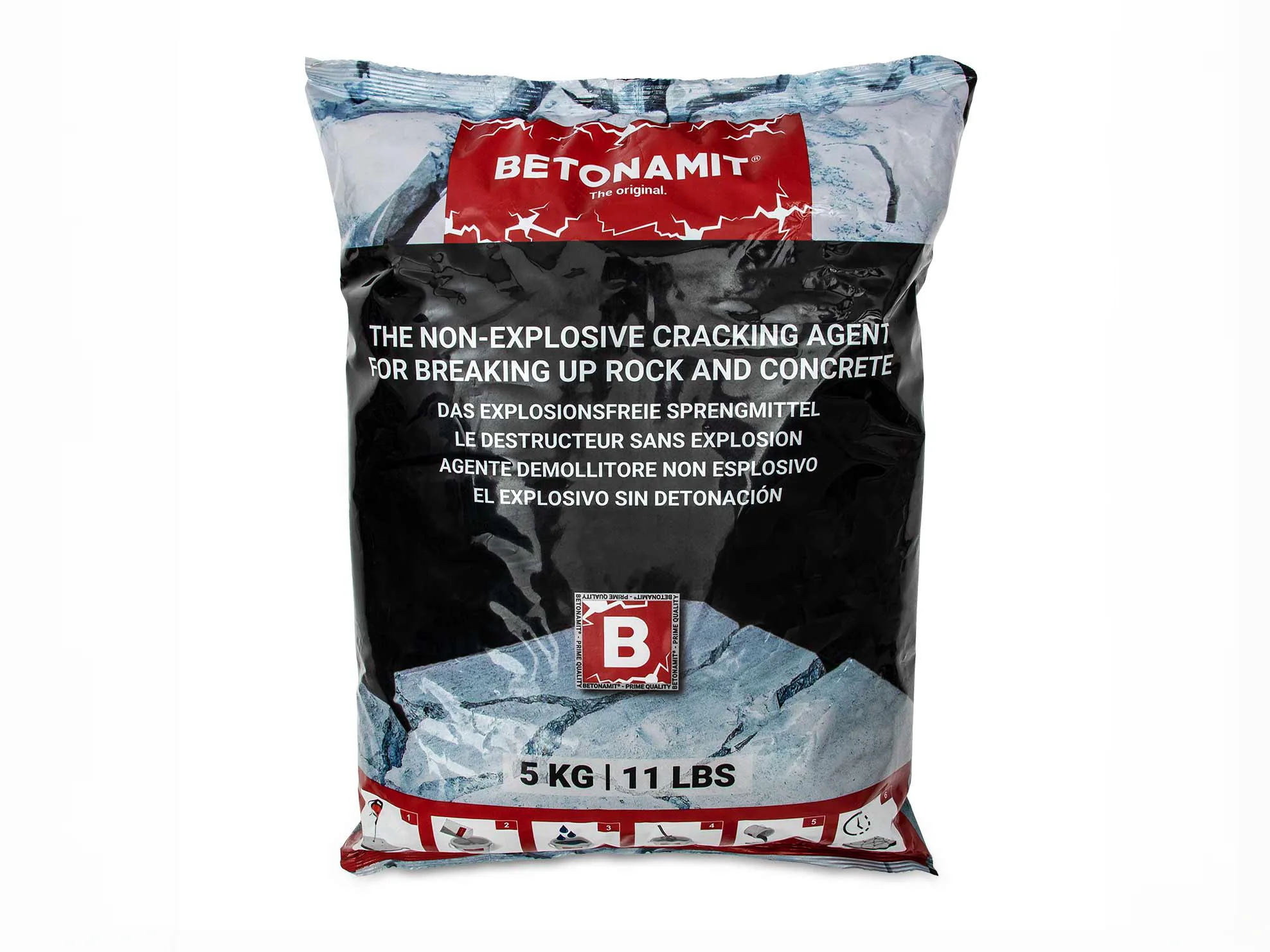
Bag 5 kg
Single bag | 11 lbs
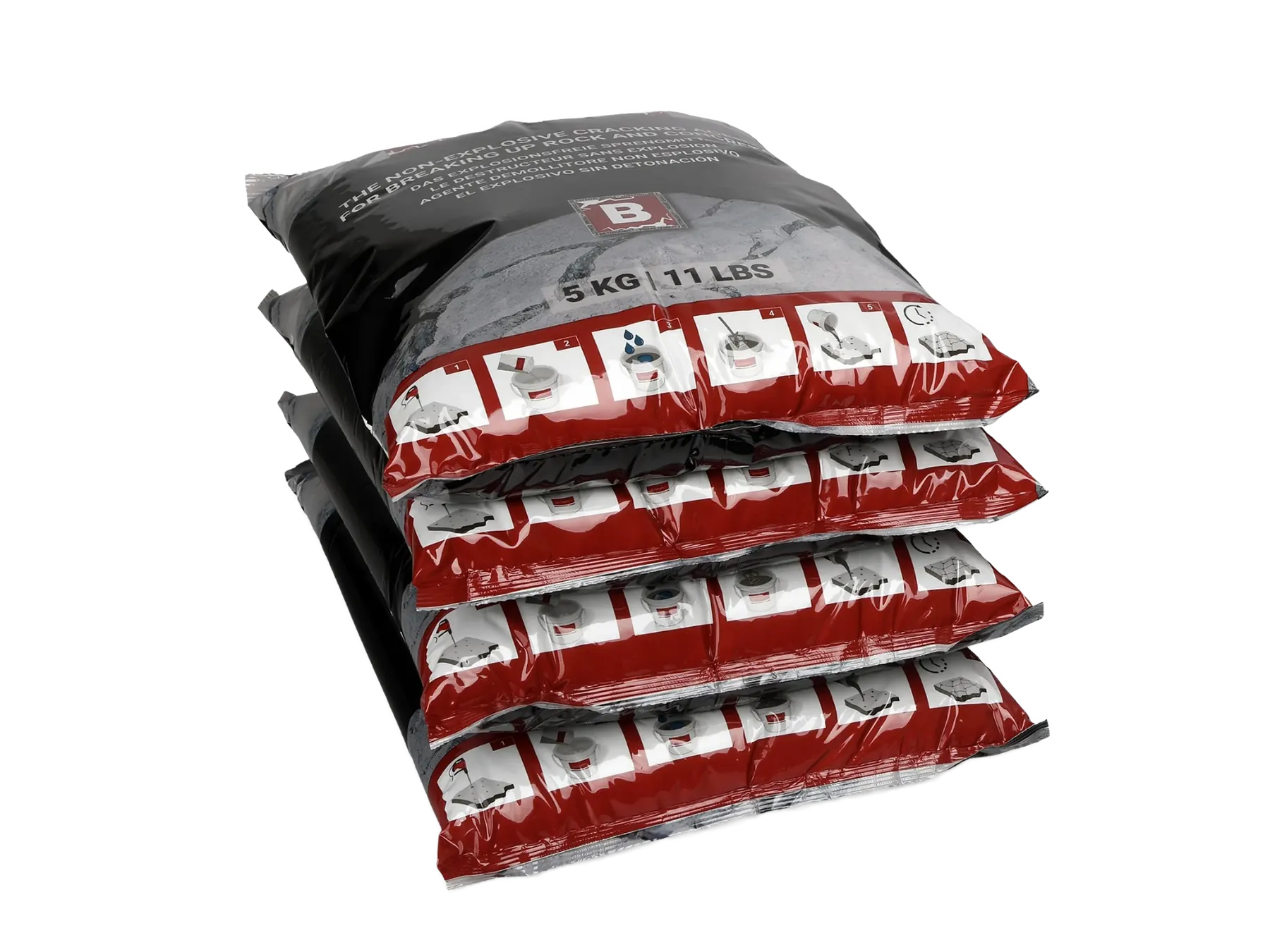
Stacked bags
5 kg bags with application pictograms
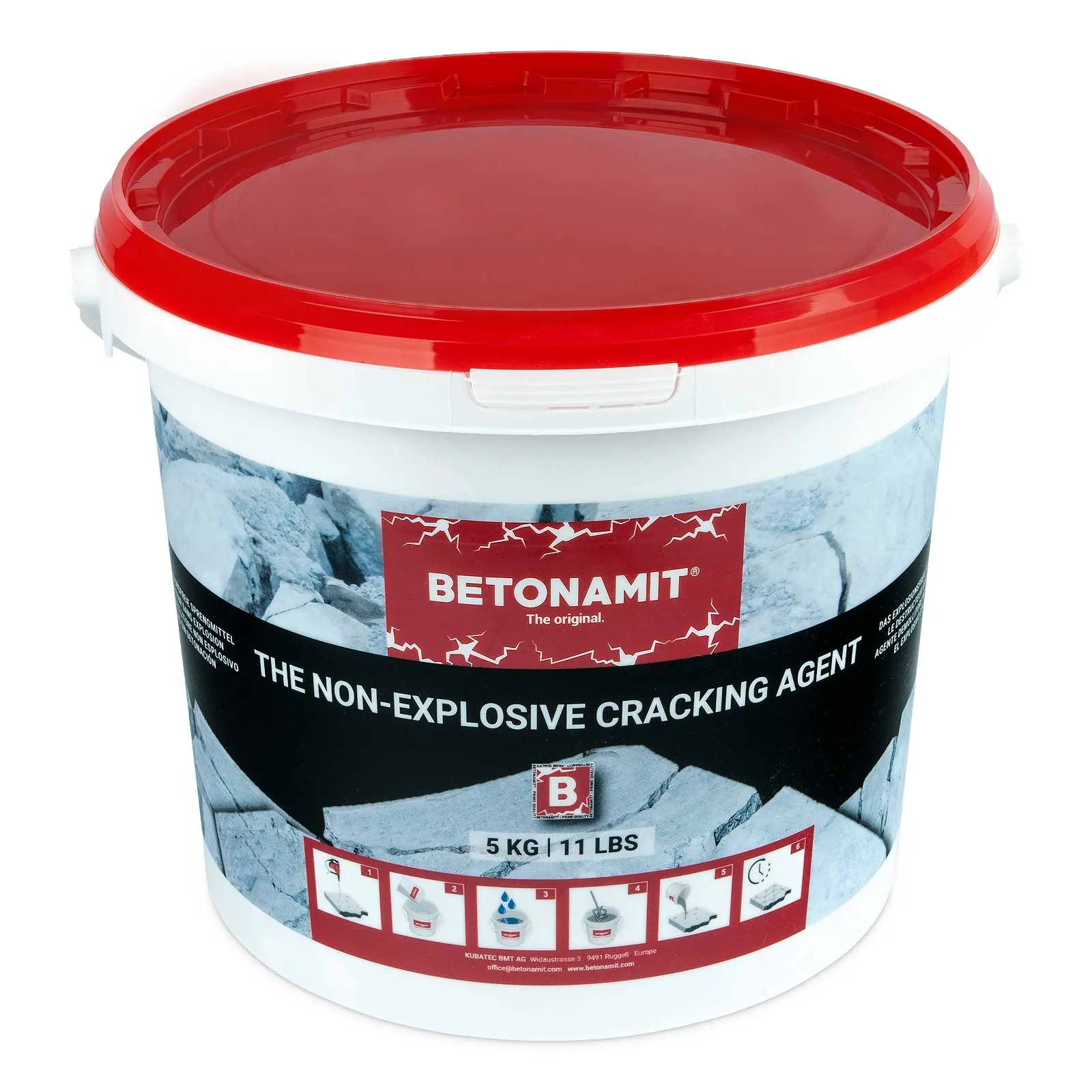
Bucket 5 kg
Resealable | 11 lbs
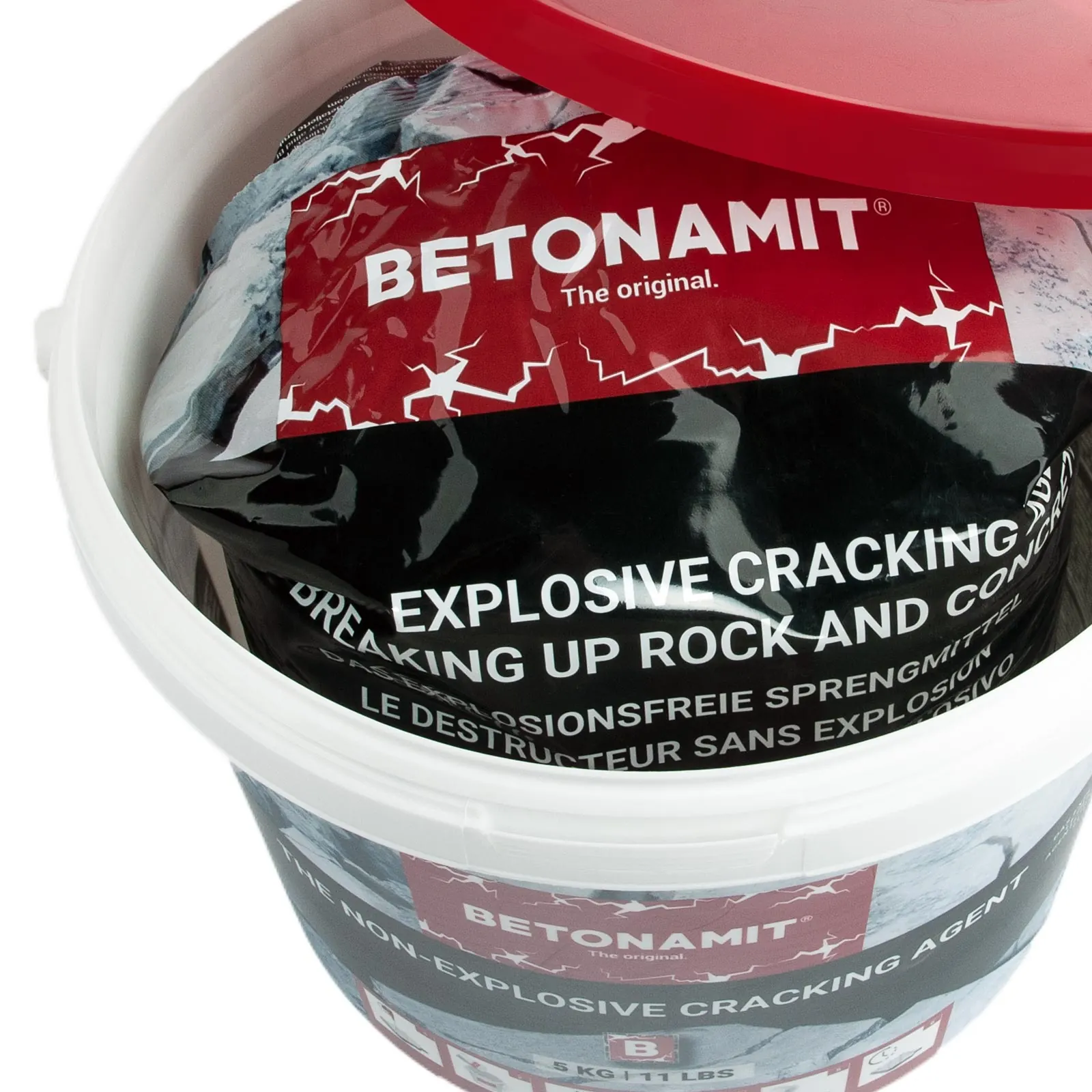
Bucket opened
Protective inner bag
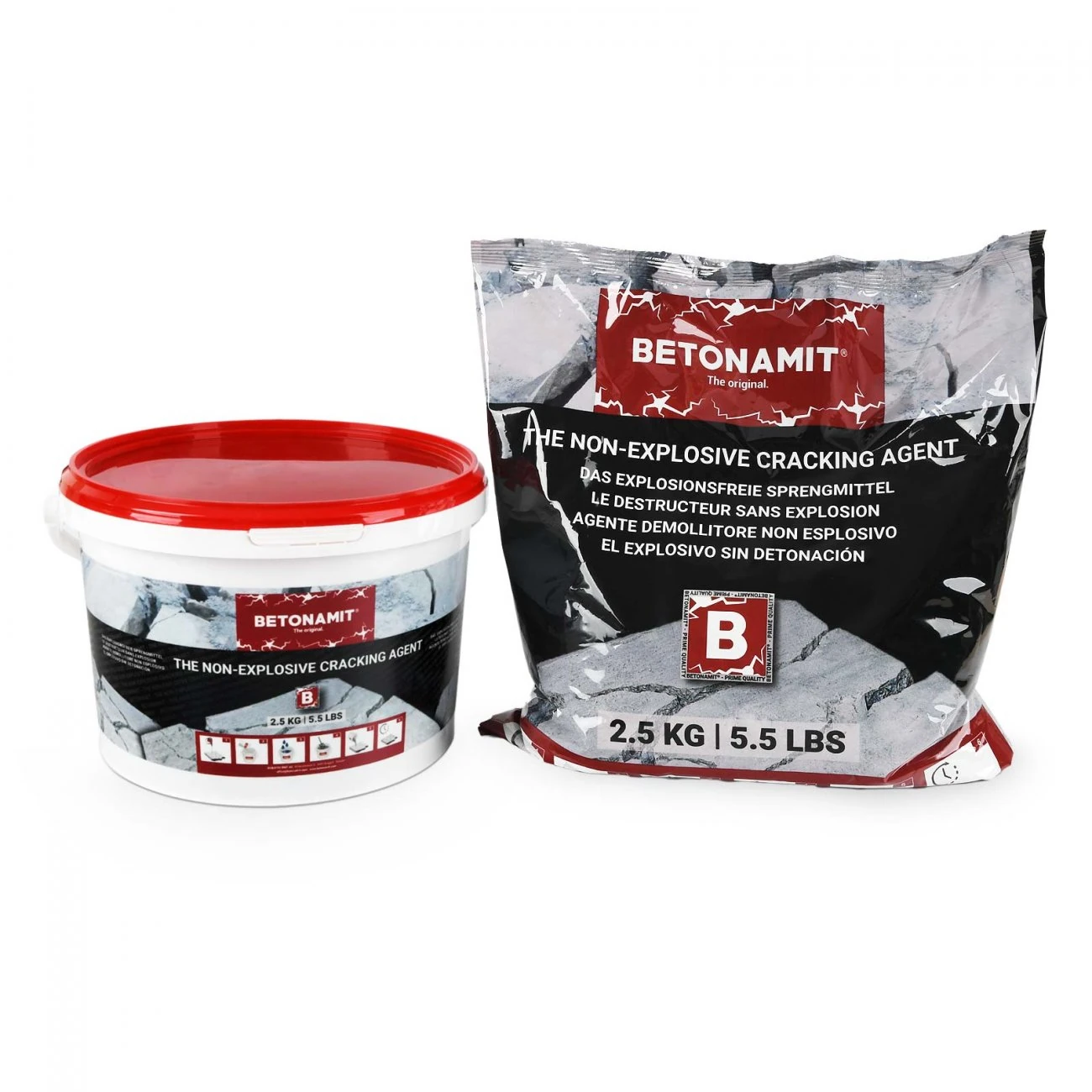
Bag and bucket 2.5 kg
2.5 kg each | 5.5 lbs
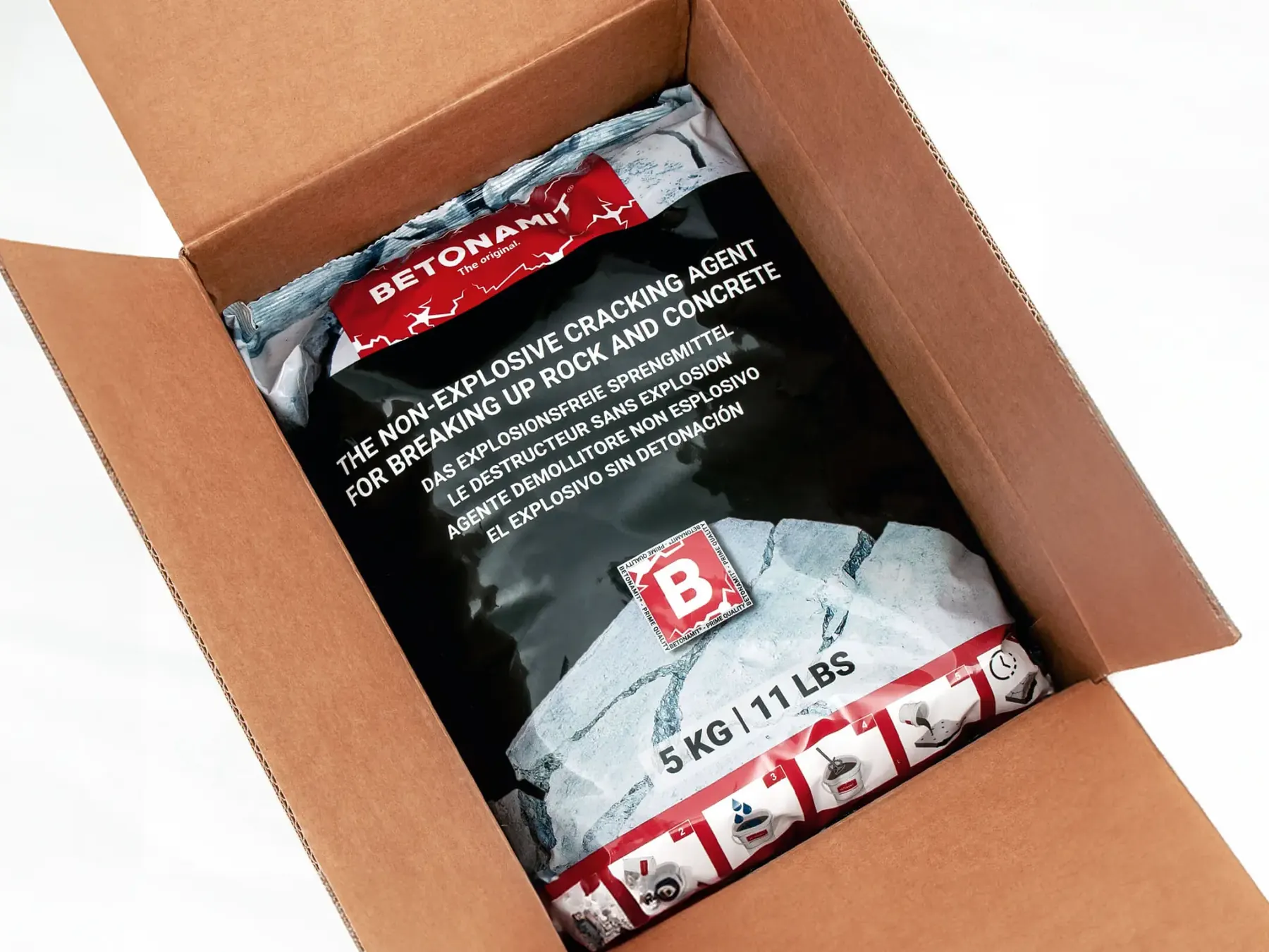
Shipping box
Carton with 4 × 5 kg, top view
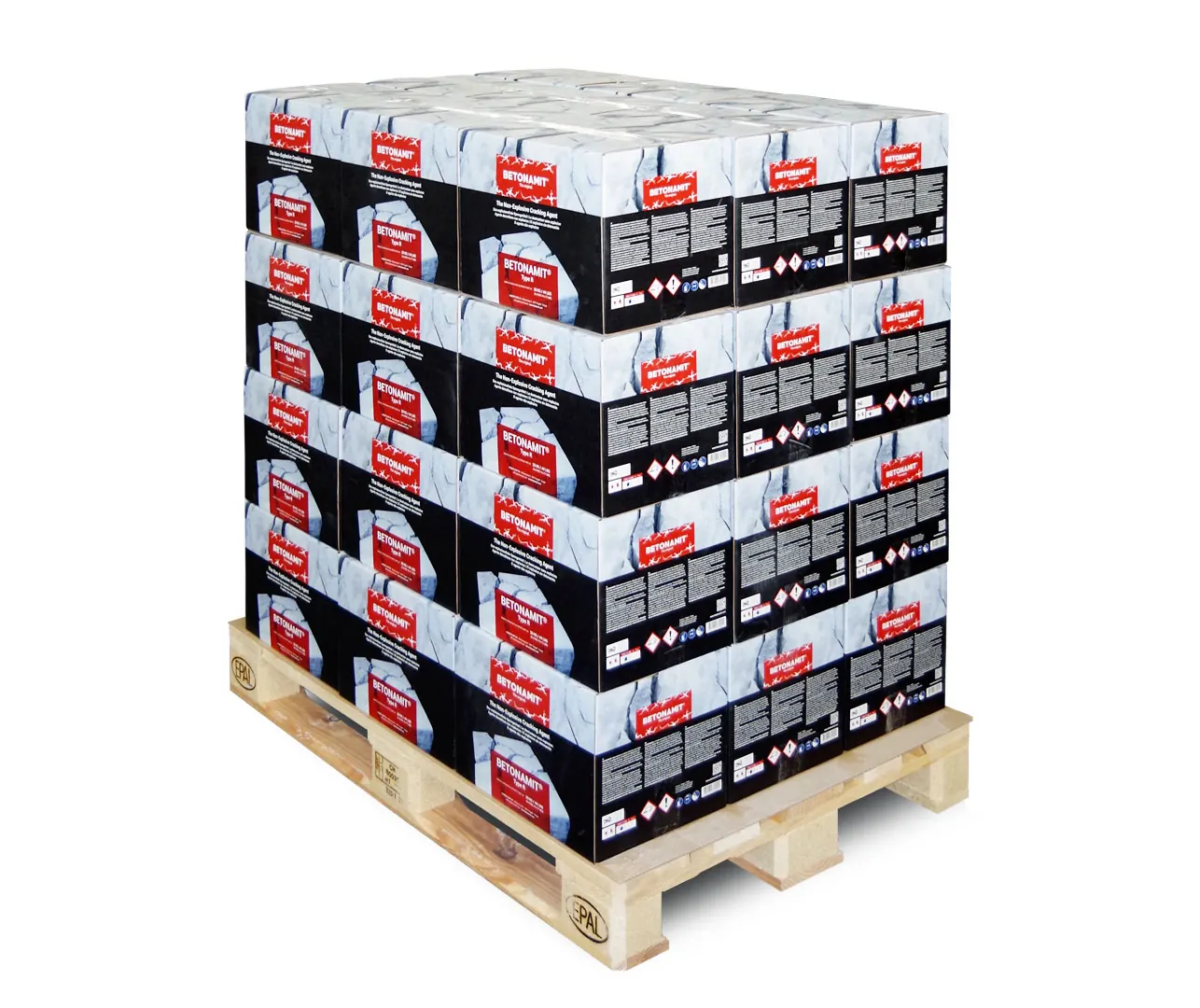
Pallet 720 kg
36 boxes of 20 kg | EPAL
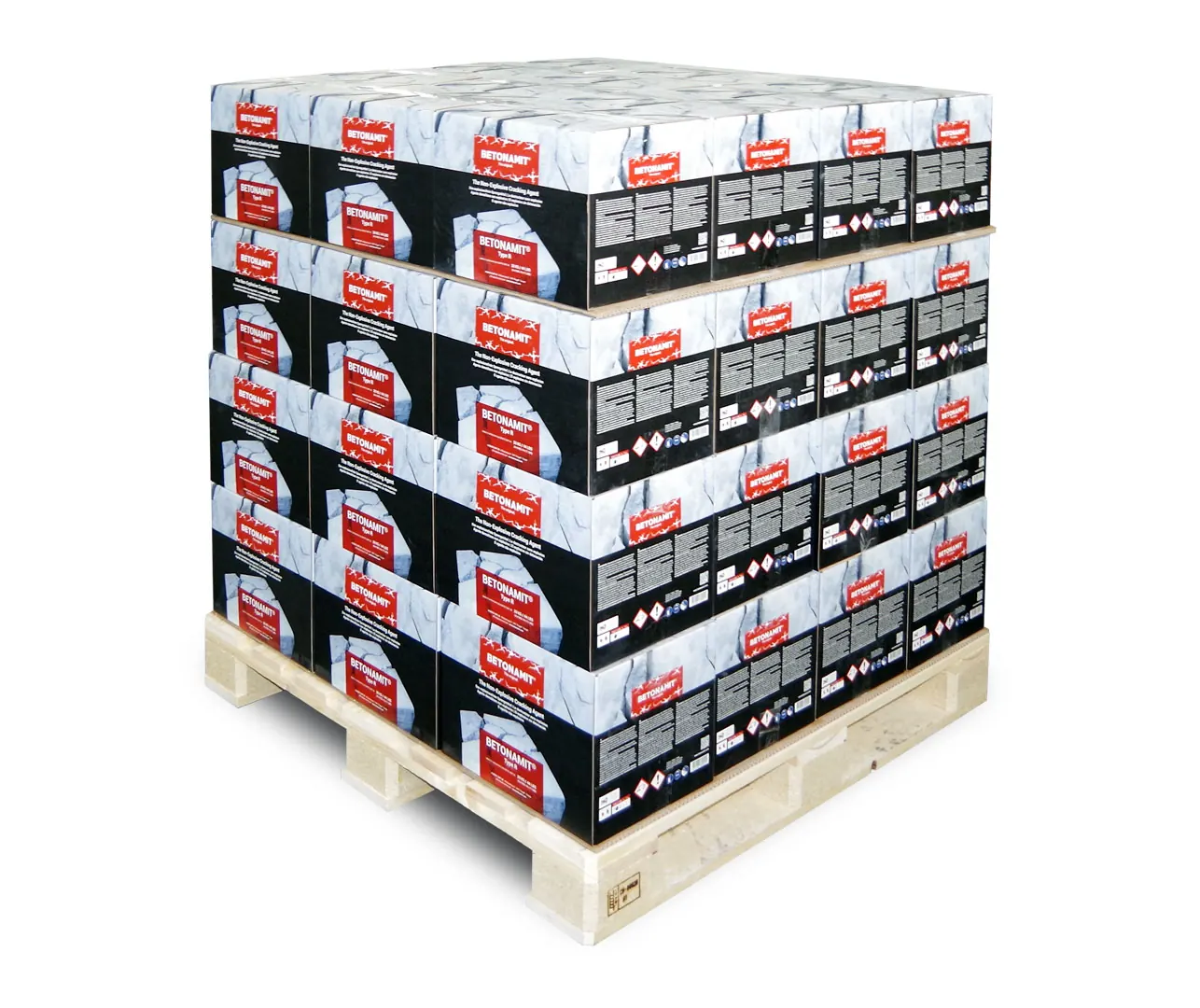
Pallet 960 kg
48 boxes of 20 kg | EPAL
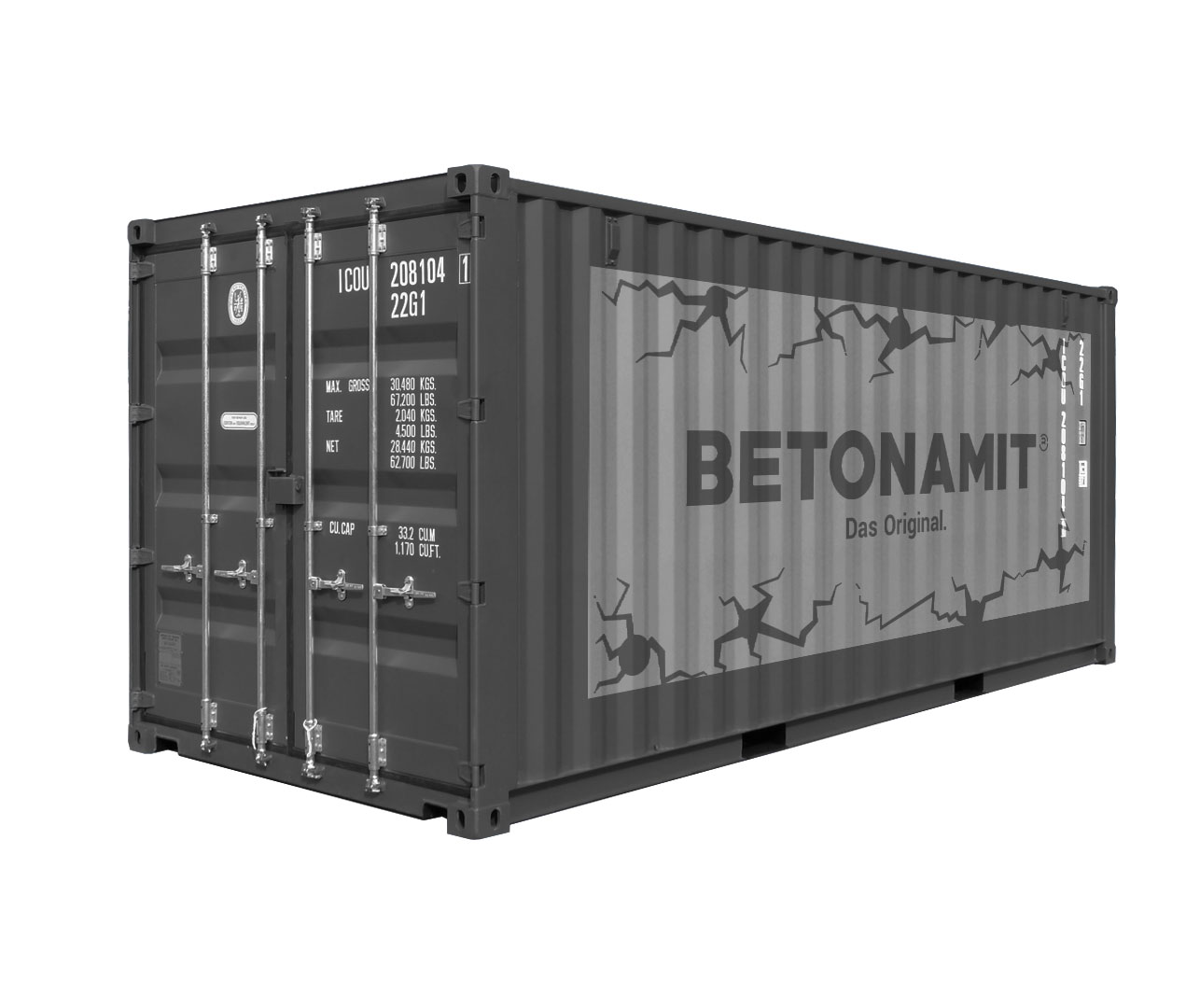
20′ FCL – 9.6 tonnes
Full container load, standard loading
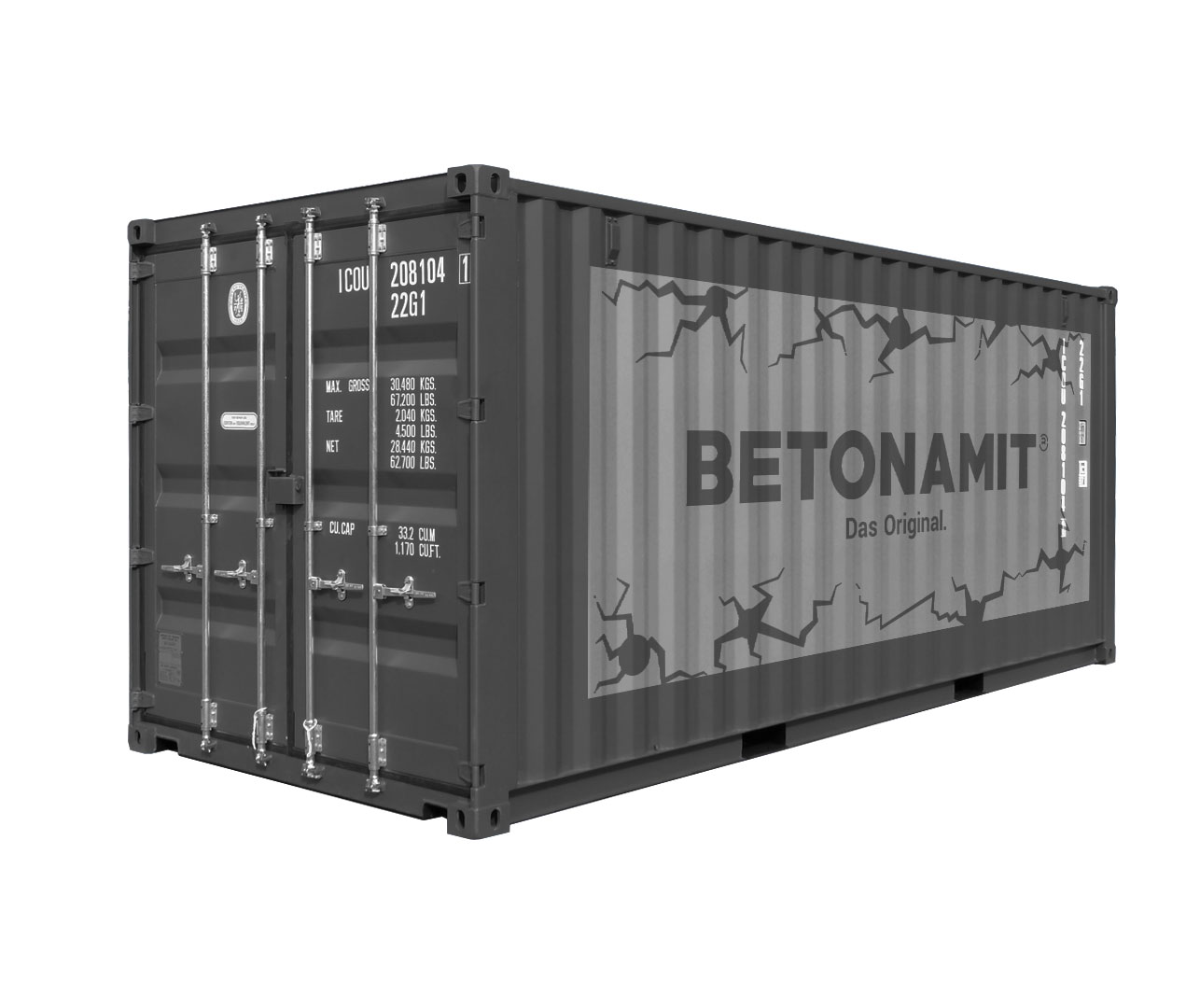
40′ FCL – 19.2 tonnes
Full container load, standard loading
Pallet and container loads are flexible and adapted to each project – packaging sizes, quantities and mixed loads on request.
Videos
These videos show BETONAMIT® in action: how the expansive demolition agent builds up pressure inside the drill holes and splits rock and concrete in a controlled way – with the reaction shown step by step in slow motion.
The field video shows BETONAMIT® splitting rock in a controlled way without explosives.
BETONAMIT® in action: controlled rock splitting without blasting.
Slow motion reveals how BETONAMIT® builds controlled expansive pressure until clearly visible cracks open.
BETONAMIT® breaking a concrete foundation – slow-motion footage with sound.
Project examples
Images from the field: rock, natural stone and concrete are broken up in a controlled way without blasting, vibration or noise – even in tight excavations, inside basements or in the middle of residential areas.
FAQ
BETONAMIT® is a non-explosive non-explosive cracking agent (SCDA) for the controlled demolition of rock and concrete. The powder is mixed with water, poured into drill holes and builds up expansive pressure while curing, cracking the material silently and without vibration.
Consumption depends on hole diameter and depth. As a rule of thumb, 1 kg fills about 1.2 m of a 32 mm hole. A consumption calculator on the product page gives the exact quantity for your project. Our guide to drill patterns, borehole spacing and drilling depth explains how to select the geometry.
One single product covers the whole range from 0 °C to 35 °C rock temperature, so there is no need for separate summer or winter grades.
Cracks normally appear within 8 to 24 hours after filling, depending on the material, hole spacing and temperature. The expansive pressure continues to develop over several days, as explained under reaction time and pressure development.
BETONAMIT® is not an explosive under explosives legislation and is not subject to special transport or storage regulations. A blasting licence is therefore usually not required – always verify local regulations.
Standard packaging is 20 kg boxes (4 × 5 kg) and 10 kg boxes (4 × 2.5 kg), 5 kg and 2.5 kg buckets as well as 5 kg and 2.5 kg bags. Customer-specific packaging and private label designs are available on request.
Quantities below one pallet (720 kg) are best sourced from one of our international sales partners or online shops. For larger volumes and private label projects, KUBATEC BMT AG quotes directly as the manufacturer.
Distribution
Click a location on the map or select a country.
Drag the map to move it, pinch or double-tap to zoom in.
85 sales partners
PROTON d.o.o.
1000 Ljubljana
Austin Powder Vertriebsgesellschaft mbH
8813 St. Lambrecht
Betonamit Austria – Christian Peter Högl
4300 St. Valentin
August Rädler GmbH – Das Bauzentrum
6922 Wolfurt
Würth Hochenburger GmbH
2201 Hagenbrunn
LCS Pipelines GmbH
6700 Lorüns
Christoph Ludescher
LCS Pipelines GmbH
6700 Lorüns
Christoph Ludescher
LDS Construct bv
3090 Overijse
PROTON d.o.o.
1000 Ljubljana
JET CONTRACTORS
Cotonou, Littoral
LCS Pipelines GmbH
6700 Lorüns
Christoph Ludescher
PROTON d.o.o.
1000 Ljubljana
Windy Ridge Corporation
Canada
CONSTRUCTORA OSME SpA
Chillán, Región de Ñuble
LCS Pipelines GmbH
6700 Lorüns
Christoph Ludescher
PROTON d.o.o.
1000 Ljubljana
TSIRCON CO LTD
P.O. Box 23863 1687 Nicosia
SDS-Stavební společnost s.r.o.
667 01 Vojkovice
PROTON d.o.o.
1000 Ljubljana
PROTON d.o.o.
1000 Ljubljana
SIA SEŠI SPĀRNI
LV-1026 Rīga
PROTON d.o.o.
1000 Ljubljana
Rakennuskemia Oy
05800 Hyvinkää
Semtu Oy
04240 Talma
PROTON d.o.o.
1000 Ljubljana
DMO – Groupe MO
73000 Chambéry
BETONAMIT Europe
96346 Wallenfels
PROTON d.o.o.
1000 Ljubljana
Building Solutions LLC (BS)
0159 Tbilisi
Building Solutions LLC (BS)
Batumi
BETONAMIT Deutschland
96346 Wallenfels
MC-Bauchemie Ghana Limited
Accra
DK Construction Limited
Tema, Greater Accra Region
PROTON d.o.o.
1000 Ljubljana
WM Guadeloupe
97122 Baie-Mahault
Emirent Gépkölcsönző Extrákkal
1037 Budapest
PROTON d.o.o.
1000 Ljubljana
LCS Pipelines GmbH
6700 Lorüns
Christoph Ludescher
PROTON d.o.o.
1000 Ljubljana
Punto Edil srl | Hey Casa
82020 Paduli (BN)
LCS Pipelines GmbH
6700 Lorüns
Christoph Ludescher
SIA SEŠI SPĀRNI
LV-1026 Rīga
PROTON d.o.o.
1000 Ljubljana
KUBATEC BMT AG
9491 Ruggell
SIA SEŠI SPĀRNI
LV-1026 Rīga
PROTON d.o.o.
1000 Ljubljana
PROTON d.o.o.
1000 Ljubljana
Kyusen Machinery & Construction Sdn Bhd
47120 Puchong
LCS Pipelines GmbH
6700 Lorüns
Christoph Ludescher
A.B.B.S. Ltd (BigMat Malta)
ATD 4000 Ta’ Qali / Attard
Bâtiment Chemicals Maroc (BATICHEM)
B.P. 84 Nouaceur, Casablanca
LCS Pipelines GmbH
6700 Lorüns
Christoph Ludescher
MASE TRADING Machinery Attachments B.V.
8171 PG Vaassen
PROTON d.o.o.
1000 Ljubljana
Rockbond Special Concrete Products Ltd
5012 Petone, Lower Hutt
Steinhardt AS
7010 Trondheim
LCS Pipelines GmbH
6700 Lorüns
Christoph Ludescher
Elsons Corporation
Karachi
Chem Masters del Perú S.A. (CHEMA)
15081 Lima
PROTON d.o.o.
1000 Ljubljana
BC – Equipa de Aluguer, Lda.
2840-131 Seixal
PROTON d.o.o.
1000 Ljubljana
LCS Pipelines GmbH
6700 Lorüns
Christoph Ludescher
BAICULESCU CONSTRUCT SRL
021586 București, Sector 2
GLOBALTEH CONSTRUCT S.R.L.
023014 București
PROTON d.o.o.
1000 Ljubljana
LCS Pipelines GmbH
6700 Lorüns
Christoph Ludescher
Batichimie Boval
Dakar
Leycochem Leyde doo
18000 Niš
Martin Svetlik
PROTON d.o.o.
1000 Ljubljana
PROTON d.o.o.
1000 Ljubljana
LCS Pipelines GmbH
6700 Lorüns
Christoph Ludescher
Bergarbete VTX AB
472 93 Svanesund
KUBATEC BMT AG
9491 Ruggell
Luxor Technology and Trade (LTT)
1082 Tunis
WLP BARUT TİCARET A.Ş.
06530 Ankara
Khambati Impex Company Limited
Kampala
LCS Pipelines GmbH
6700 Lorüns
Christoph Ludescher
Norsekem Ltd
RG40 5PR Wokingham
Windy Ridge Corporation
General importerNH 03886 Tamworth
Crowder Supply Co., LLC
CO 80216 Denver
Blasters Tool & Supply Co.
KY 40342 Lawrenceburg
Ideal Blasting Supply
NC 28813 Asheville
Atlas Preservation
CT 06037 Berlin
Maharat Bena'a Corporation
Sana'a
From one pallet upwards, it pays to contact us directly: when timing is not critical, buying directly from KUBATEC is usually the most economical option. Simply request a non-binding quote.