
Application
Splitting boulders: breaking large rocks without blasting
From field stones to boulders weighing several tonnes: drill pattern, quantity required and procedure for safe splitting in agriculture, landscaping and civil engineering.
- Hole diameter
- 30–40 mm with a rotary hammer
- Hole spacing
- 30–50 cm depending on the rock
- Drilling depth
- 80–95 % of the block height
- Result
- manageable, low-crack segments
Starting point
The block is usually in the most awkward place
Boulders appear exactly where they cause the most trouble: in the middle of a field, in the planned foundation area, in the garden behind the house or on a slope without access. Blasting is practically impossible in a residential setting, a hydraulic hammer needs machine access and produces noise and flying rock, and removing the block whole often fails on crane capacity and ground bearing capacity.
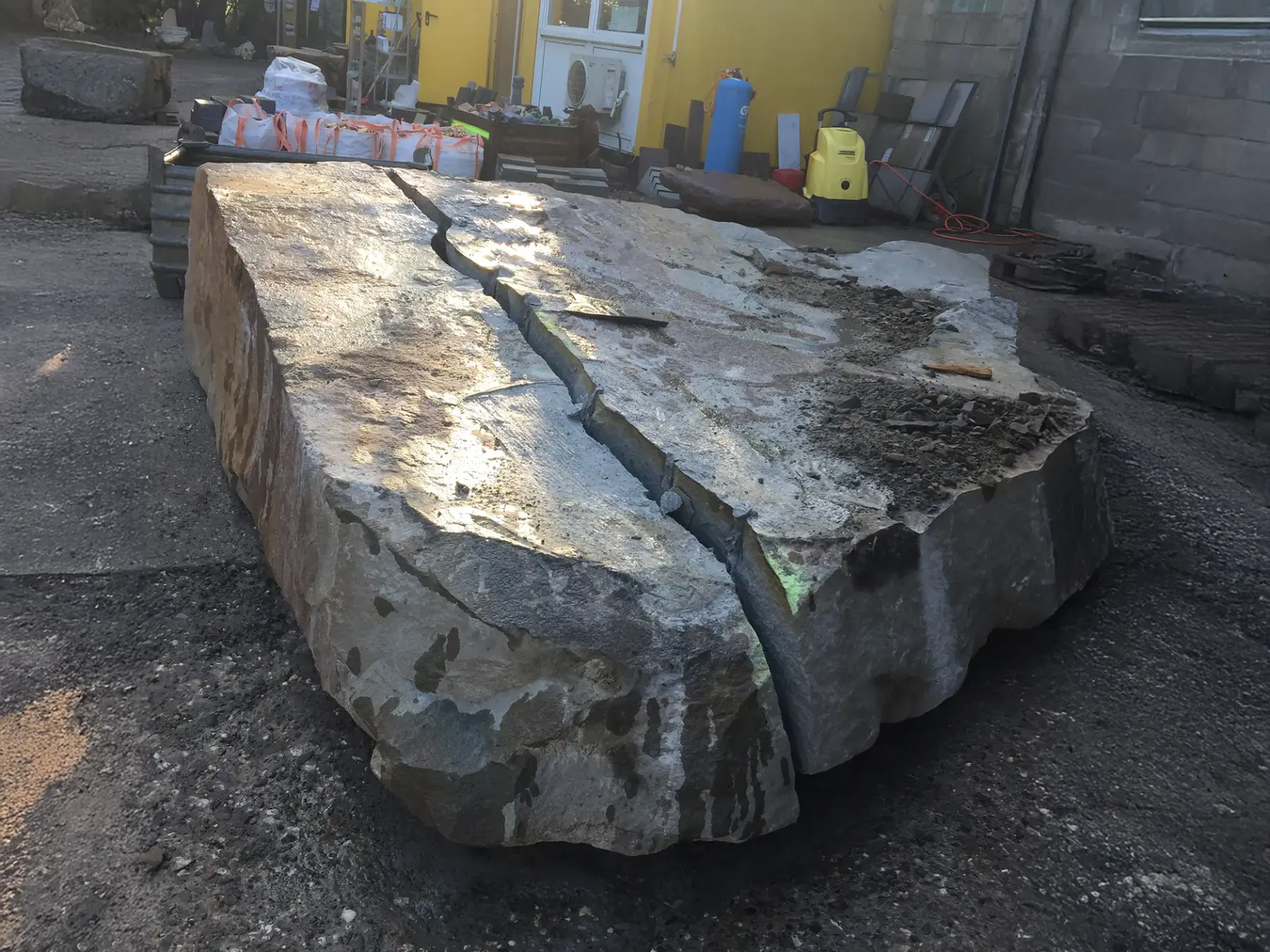
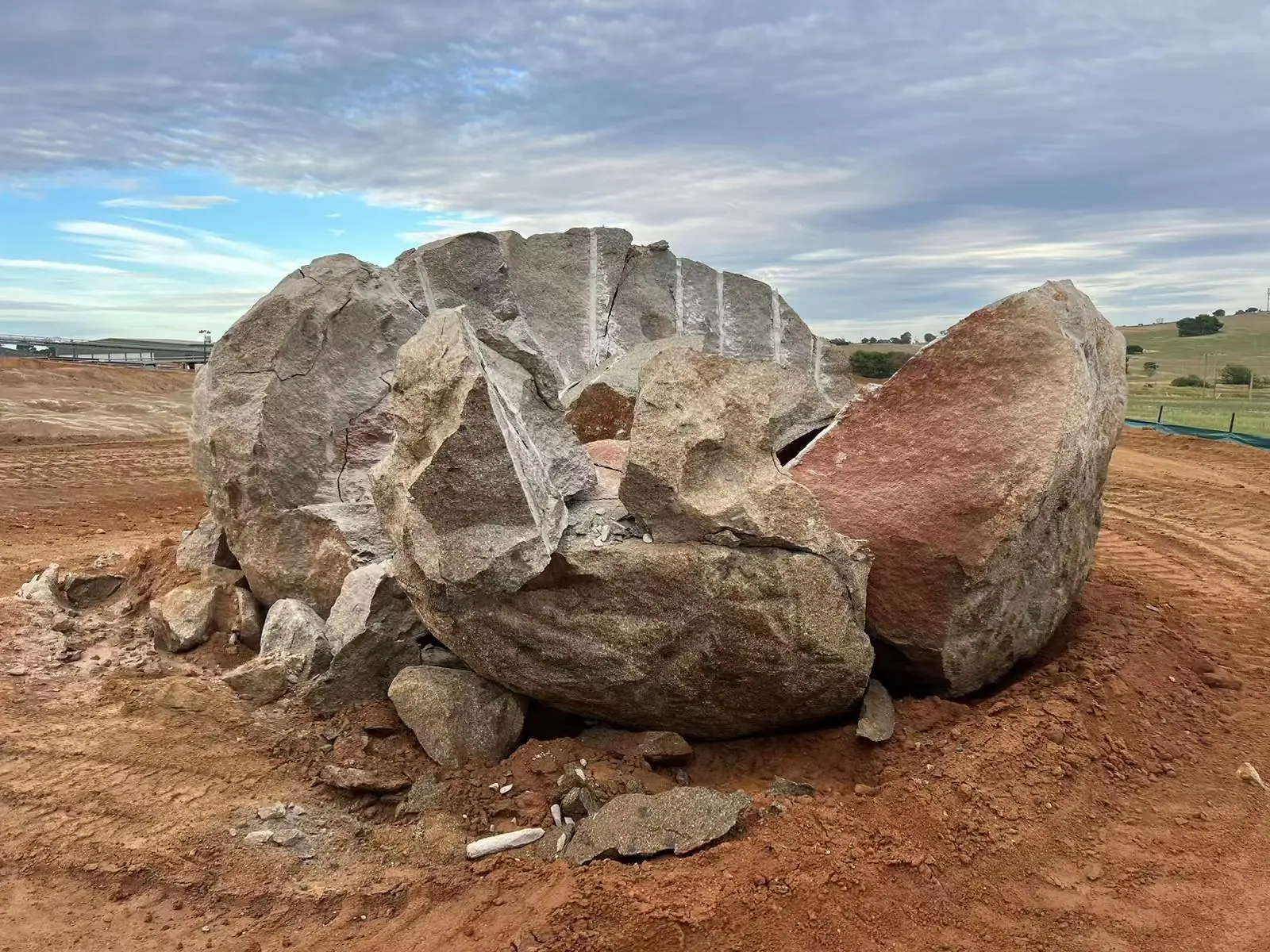
With expansive mortar the block is broken up where it lies. All that is needed is a drill, water and the material. Because pressure builds up slowly there is no flying debris – not even next to glass façades, greenhouses, vehicles or pasture fences.
Procedure
How a boulder is broken up
01
Choose the separation plane
Use visible cracks, veins and bedding. The row of holes lies in the plane along which the block should come apart – several planes are possible too.
02
Drill
30–40 mm holes spaced 30–50 cm apart, as deep as possible. Exposed blocks can be drilled from above, partly buried ones also from the side.
03
Fill
Remove drilling dust, mix the material as specified and fill the holes to the brim. Cover the area with fleece or a board, but do not plug it.
04
Break up
After 8–24 hours the block has cracked. Separate the segments with a bar, stone grab or loader; for smaller pieces re-drill the segments.
Quantity required
How much material is needed?
Consumption depends solely on borehole volume, not on the volume of the stone. Rule of thumb: 1 kg of powder fills roughly 0.55 litres of borehole. A 40 mm hole 1 m deep has a volume of about 1.26 litres and therefore requires approx. 2.3 kg. A 2 m³ boulder split with four holes of 0.8 m each thus comes to around 7 to 8 kg.
Available pack sizes – from the 5 kg bucket for one-off jobs to full pallets for continuous commercial use – can be found on the BETONAMIT® product page and, for rock applications, at ROCKSPLIT®.
Fields of use
Who works with it
- Agriculture: breaking up field stones without machinery
- Garden and landscaping: reducing blocks in an existing garden
- Civil engineering: removing boulders in pits or trench areas
- Forestry and road construction: splitting blocks on tracks and bends
- Alpine construction: block removal without access roads or helicopter equipment
- Natural stone: bringing raw blocks to workable size with minimal cracking
Assessment
Advantages and limitations
Advantages
- +No flying debris – safe next to buildings, vehicles and livestock
- +No excavator and no hydraulic system required
- +Also usable for blocks without access or on slopes
- +Fragments stay low in cracks and remain reusable
- +Silent – no conflicts with neighbours or quiet hours
Limitations
- –Drilling is manual work and time-consuming in hard rock
- –The result only becomes visible after the waiting time
- –Very flat or thin blocks offer too little drilling depth
- –In frost, the product variant and covering are decisive
FAQ
Frequently asked questions about splitting boulders
+How many holes does a boulder need?
For a block of up to about 1 m³, a single row of two to four holes along the desired separation plane is often enough. For larger blocks, several rows spaced 30 to 50 cm apart are set to obtain manageable pieces.
+Can it be done without an excavator?
Yes. That is precisely one of the main arguments: drilling is done with a rotary hammer or petrol drill, filling by hand. Once cracked, the pieces can be moved with a bar, front loader or stone grab – entirely without heavy machinery on hard-to-access terrain.
+How large may a block be?
There is practically no upper limit. Blocks of several dozen tonnes are routinely broken up in several stages: first halving along the main plane, then re-splitting the segments.
+Is the stone still usable afterwards?
Yes. Because there is no detonation, the fragments remain largely free of cracks and can be reused as block steps, wall stones or armour stone.
Read on
Related topics
Expansive mortar
How it works, how it developed, drill patterns and the limits of non-explosive splitting – explained concisely.
Alternative demolition methods
Hammer, wire saw, splitting cylinder, conventional blasting or expansive mortar: when each method pays off.
Rock excavation
Building pits, road construction, tunnel re-profiling – breaking rock without vibration and without a blasting permit.
Concrete demolition
Separating foundations, plinths and mass concrete in a controlled way indoors and in populated surroundings.
Reaction time
First cracks after 8–16 hours are only the beginning: pressure continues to rise for several days and peaks after about one week.
Drill pattern
10 × Ø rule, conservative 6–8 × Ø starting value, half spacing at a free edge and sufficiently deep boreholes: the fundamentals of a good drill pattern.
Business location Liechtenstein
Highly industrialised, politically and financially stable, globally connected: the location behind BETONAMIT® and ROCKSPLIT®.
Mechanical application
Mix and pump BETONAMIT by machine: tonnes instead of kilograms – process, MAI mixing pump, water setting of 1.0–1.2 litres per 5 kg and safety.
Determine the requirement for your block
Send us the dimensions and rock type – we will recommend drill pattern, product and quantity.